戮
Character Story & Explanation
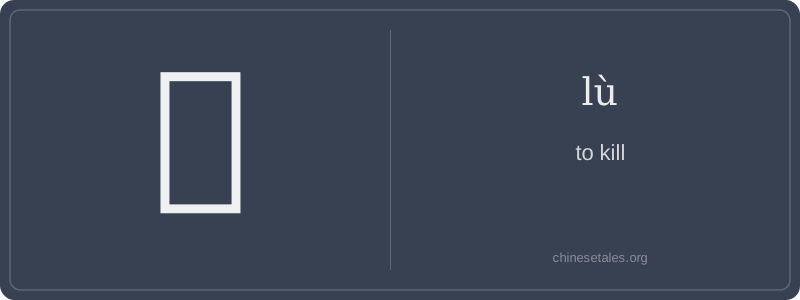
The earliest forms of 戮 appear on Western Zhou bronze inscriptions as a compound pictograph: a halberd (戈) beside a kneeling person (the top part evolved from 廴 + 丿 + 一, representing a bound, subdued figure). By the Warring States period, the left side solidified into the 戈 radical, while the right side condensed into 羽 (yǔ, feather) — not because of birds, but as a phonetic component (ancient pronunciation was close to *luk*). Over centuries, the ‘kneeling figure’ simplified into the 15-stroke structure we see today: 戈 + 羽, with the lower strokes suggesting shackled limbs and the downward slash of the halberd’s blade.
This visual logic shaped its meaning: not random killing, but *state-sanctioned execution* — the ritual slaying of criminals or enemies before ancestral altars. In the *Zuo Zhuan*, Duke Zhuang of Zheng 戮 his treacherous brother at the altar of the soil god — a political act made sacred by the character’s very strokes. Later, Confucian scholars reframed 戮 as moral purification: ‘If the ruler fails, he must be 戮 in spirit before the people.’ Even today, the compound 戮力同心 preserves that sense of unified, disciplined exertion — as if channeling lethal focus into collective purpose.
At its core, 戮 (lù) isn’t just ‘to kill’ — it’s *ritualized, collective, often punitive killing*. Think executioner’s blade in ancient law codes, not battlefield chaos. It carries gravity, formality, and moral weight: you don’t 戮 a mosquito; you 戮 a traitor. The character feels archaic and literary — it’s almost never used in spoken Mandarin today, and you’ll only encounter it in classical texts, historical dramas, or formal legal/moral condemnations (e.g., ‘戮力同心’ — literally ‘kill-force together’, meaning ‘unite with all one’s strength’).
Grammatically, 戮 is almost always transitive and formal. It pairs with high-register nouns: 戮敌 (lù dí, ‘slay the enemy’), 戮尸 (lù shī, ‘mutilate the corpse’ — a grave insult in classical usage). Unlike modern verbs like 杀 (shā), which can be neutral or even colloquial (‘I killed the Wi-Fi password’), 戮 *always* implies intentionality, severity, and often state sanction. Learners mistakenly use it as a fancy synonym for 杀 — but that’s like swapping ‘decapitate’ for ‘cut’ in English: same action, wildly different register and connotation.
Culturally, 戮 appears in foundational phrases like 戮力同心 (lù lì tóng xīn), where its original violent force has softened into ‘exerting utmost effort together’. This semantic softening is rare and fascinating — the character retained its shape but shed blood, becoming a symbol of disciplined unity. A common mistake? Confusing it with 戊 (wù) or 虜 (lǔ) — both visually close, but utterly unrelated in meaning. Remember: 戮 *always* involves the戈 (gē, halberd) radical — this is a weapon wielded by authority, not passion.