剸
Character Story & Explanation
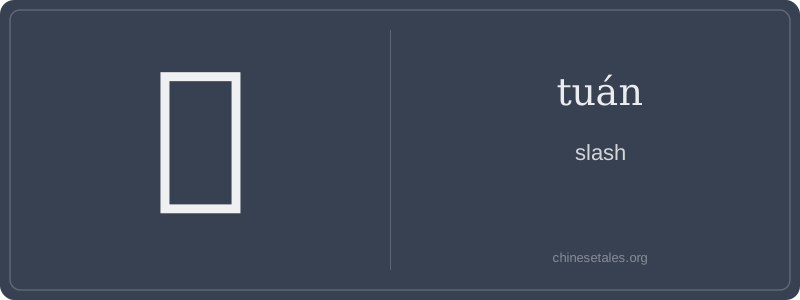
The earliest form of 剸 appears in Warring States bamboo slips as a complex composite: left side showing a hand (扌) gripping a sharp, curved blade (originally resembling a ritual bronze dao), right side depicting a tangled mass of threads or vines—visually evoking something knotted, obstructive, and in need of resolution. Over centuries, the ‘threads’ simplified into the phonetic component 專 (zhuān), while the hand-and-blade evolved into the modern 扌+專 structure—retaining the essence of 'hand wielding a blade to sever entanglement.'
This visual logic directly shaped its meaning: in the Zuo Zhuan, 剸 describes how Duke Wen of Jin ‘cut through chaos’ (剸亂) to restore order—using not brute force, but discernment and decisive action. By the Tang dynasty, it became synonymous with administrative mastery: a prefect who could 剸繁治剧 (‘slash through complexity and govern intense affairs’) was praised as near-sage-like. The character never meant ‘chop randomly’—its strokes encode intentionality, control, and intellectual precision, turning physical slashing into a metaphor for mental clarity.
Think of 剸 (tuán) as the Chinese equivalent of a 'precision cleaver'—not the gentle slice of a chef’s knife, but the decisive, almost ceremonial slash of a magistrate’s blade in a Ming dynasty legal drama. Its core meaning isn’t casual cutting—it’s forceful, authoritative severing: to cut *through* obstruction, to resolve complexity with one clean, final stroke. Unlike common verbs like 切 (qiē, 'to slice') or 割 (gē, 'to cut off'), 剸 carries literary weight and moral gravity—it’s the verb you’d use for 'cutting through red tape' in classical prose, not for dicing onions.
Grammatically, 剸 is almost exclusively transitive and highly formal—never used alone in modern speech. It appears mainly in set phrases (like 剸繁治剧) or classical-style compound verbs, often paired with abstract nouns: 剸疑 ('cut through doubts'), 剸难 ('slash through difficulties'). Learners mistakenly try to use it like a general-purpose verb ('I 剸 the rope'), but it resists that—it demands an object that’s *conceptually entangled*, not physically tangible. You wouldn’t 剸 an apple; you might 剸 a bureaucratic knot.
Culturally, 剸 echoes Confucian ideals of administrative clarity: a good official doesn’t muddle or delay—they 剸. Mistake it for 刖 (yuè, 'to amputate') or 段 (duàn, 'section'), and you’ll conjure images of dismemberment or mere segmentation—not the elegant, decisive authority this character embodies. Its rarity today (absent from HSK, dictionaries, even most native speakers’ active vocab) makes it a linguistic fossil—beautiful, precise, and utterly out of time.