铲
Character Story & Explanation
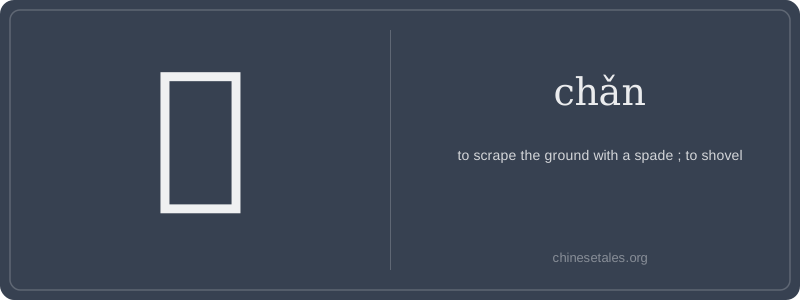
Oracle bone inscriptions don’t show 铲 directly, but its ancestor appears in bronze script as a compound pictograph: a stylized metal blade (金) fused with a sharp, downward-striking edge (刂), often with a curved handle implied. By the Qin seal script era, the left side had simplified to 钅 (the 'metal' radical we know), while the right evolved from 刀 (dāo, 'knife') into the compact, decisive 刂 — representing the blade’s cutting action. The 11 strokes crystallize this: 5 for 钅 (hook, dot, three horizontal strokes), then 6 for 刂 (a slanted stroke, vertical line, and four precise angular movements — like pressing a spade into dirt).
By the Han dynasty, 铲 was firmly documented in agricultural manuals like the *Fan Shengzhi Shu*, describing how farmers used iron-tipped shovels to 'scrape clean' irrigation ditches. Its meaning never strayed far from physical removal — unlike broader verbs like 取 (qǔ, 'take') or 拿 (ná, 'hold'). Even in Tang poetry, 铲 appears rarely but vividly: Li Bai once wrote of 'scraping frost from the well rim' (铲井霜), using it for delicate, precise surface removal. That visual precision — metal + edge = controlled abrasion — has held steady for over two millennia.
At its core, 铲 (chǎn) is a vivid action verb — not just 'to shovel', but specifically *to scrape or cut into the ground with a rigid, flat-edged metal tool*. Think of a farmer biting into packed earth with a spade, or a construction worker skimming concrete before it sets. The character’s metallic radical 钅 (jīn, 'metal') immediately signals materiality and force; the right side 刂 (dāo, 'knife') isn’t just decoration — it’s the cutting edge doing the work. This isn’t gentle scooping like with a spoon (勺); it’s deliberate, abrasive, ground-breaking motion.
Grammatically, 铲 is often transitive and pairs with objects indicating resistance: 铲土 (chǎn tǔ, 'scrape soil'), 铲雪 (chǎn xuě, 'shovel snow'), or even metaphorically 铲除 (chǎn chú, 'uproot/eradicate' — literally 'scrape away and remove'). Learners sometimes wrongly use it for general 'digging' (better: 挖 wā) or confuse it with stirring (搅 jiǎo). Remember: 铲 implies *surface-level scraping*, not deep excavation or mixing.
Culturally, 铲 carries gritty, hands-on connotations — it appears in idioms like 铲平 (chǎn píng, 'level by scraping'), evoking both literal land-clearing and political 'erasure'. In modern slang, 铲 also appears in internet phrases like 铲掉 (chǎn diào, 'delete/cancel' — e.g., a post), borrowing its 'remove-by-scraping' logic. A common mistake? Writing 刀 instead of 刂 on the right — but that changes the character entirely (e.g., to 针 zhēn, 'needle'). Precision matters: every stroke is part of the tool’s anatomy.