剳
Character Story & Explanation
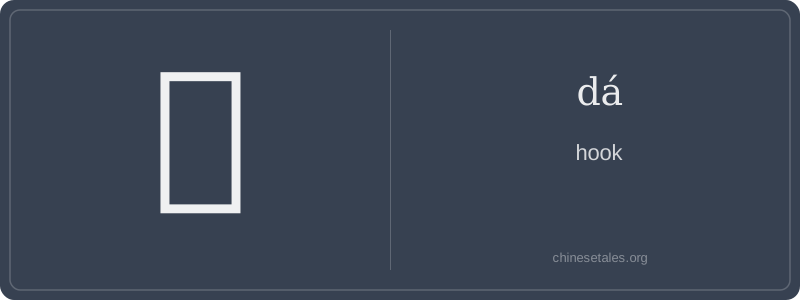
The earliest form of 剳 appears in bronze inscriptions as a composite pictograph: a simplified representation of a curved, barbed metal hook (the top part resembling 又, an ancient hand/claw glyph) combined with 刀 (knife) — later standardized as 刂 on the right. Over centuries, the left side evolved from 又 to the modern 大 (dà), likely due to phonetic borrowing (dá and dà share the same initial consonant and similar vowel) and simplification. The radical 刂 remained steadfast, anchoring the character’s association with cutting tools and sharp implements — because a functional hook must bite, not just rest.
This visual evolution mirrors semantic refinement: from generic 'grasping tool' in Shang-Zhou bronzes to a precise 'penetrating hook' by the Han dynasty. In the Book of Rites (Lǐjì), 剳 appears in descriptions of ritual bronze hooks used to lift sacrificial vessels — not merely holding, but *lifting under tension*. Later, in the Ming military treatise Jiào Bīng Jì, 剳 describes hooks deployed to pull enemy shields aside — highlighting its core nuance: *directional, resistant engagement*. Even today, its shape whispers 'pull + pierce + control' — a silent grammar lesson carved in ink.
Let’s be honest: 剳 (dá) is a quiet rebel — it means 'hook', but not the kind you hang coats on. Think of a sharp, curved metal hook used for grappling, dragging, or even surgical extraction in classical texts. Its feel is *mechanical precision with a hint of force*: it’s not decorative; it’s functional, often implying controlled pulling, snagging, or seizing. You won’t hear it in daily chat — it’s literary, technical, or historical. It’s a verb, almost always transitive, and often appears in compound verbs like 剳住 (dá zhù, 'to hook firmly') or 剳入 (dá rù, 'to hook into').
Grammatically, it behaves like a monosyllabic action verb that demands an object: you don’t just 'hook' — you 剳住绳索 (hook the rope), 剳进木梁 (hook into the beam). Learners mistakenly treat it like the common verb 钩 (gōu), but 剳 is far more specific — it implies *penetration + resistance overcome*, like a hook biting into tough material. Also, avoid reading it as 'zhā' (a common mispronunciation); its only standard reading is dá — rhyming with 'father' but with a falling tone.
Culturally, 剳 carries the weight of pre-modern craftsmanship and martial pragmatism. In Ming-Qing military manuals, 剳 often describes how grappling hooks secured siege ladders to city walls. Today, it survives in niche contexts: traditional carpentry terminology, antique weapon descriptions, and poetic metaphors ('the moonlight 剳住山脊' — moonlight hooks onto the mountain ridge). A frequent learner trap? Assuming it’s interchangeable with 挂 (guà, 'to hang') — but 剳 never means passive suspension; it always involves active, angled engagement.