剜
Character Story & Explanation
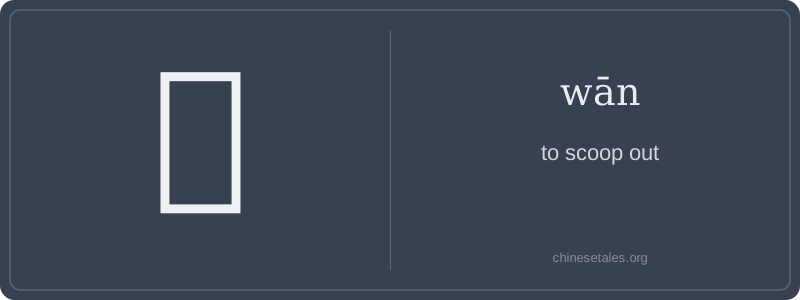
The earliest form of 剜 appears in bronze inscriptions as a compound: a hand holding a blade (the precursor to 刂) hovering over a rounded, fleshy shape—likely representing soft tissue or fruit. Over centuries, the ‘flesh’ element evolved into the left-hand component 宛 (wǎn), which originally depicted a bent arm cradling something curved. The right side solidified as 刂 (the knife radical), anchoring the action in cutting. By the Han dynasty, the structure stabilized: 宛 (suggesting both sound and the idea of 'curving inward to extract') + 刂 (knife) = the precise, concave motion of scooping. Its ten strokes aren’t arbitrary—the four dots in 宛 mimic tiny indentations, subtly echoing the hollow left behind.
In classical texts, 剜 was rare but potent: in the Ming novel Jin Ping Mei, it describes a surgeon ‘剜去腐肉’—a clinical yet haunting image. Later, regional dialects embraced it for everyday vividness: farmers ‘剜野菜’ (scoop up wild greens), cooks ‘剜枣核’ (gouge out date pits). Its visual logic is brilliant: the curved top of 宛 mirrors the arc of a spoon or knife tip diving in, while 刂 confirms the instrument. No wonder it survives—not as a relic, but as a linguistic scalpel.
Imagine holding a sharp knife and digging deeply into soft material—like scooping out the center of a pumpkin or carving a hollow in wood. That’s 剜 (wān): a vivid, tactile verb meaning 'to scoop out', 'to gouge', or 'to carve out' with force and precision. It’s not gentle scraping—it implies deliberate, often vigorous removal of a portion from a larger whole. Unlike generic verbs like 挖 (wā, 'to dig'), 剜 carries an almost surgical intensity: you’re not just digging dirt—you’re extracting something *from within*, leaving a clean cavity.
Grammatically, 剜 is a transitive verb that nearly always takes a direct object (e.g., 剜肉, 剜眼). It rarely appears alone; you’ll almost never say 'I 剜'—you’ll say 'I 剜 out the rotten part'. It frequently pairs with body parts (剜眼, 剜心) or food (剜梨肉), and it’s common in literary or descriptive writing—not daily chit-chat. Learners sometimes misapply it as a synonym for 切 (qiē, 'to cut') or 削 (xiāo, 'to peel'), but 剜 isn’t about surface removal: it’s about *excavation*. Try saying '他剜了一块西瓜' — it sounds oddly dramatic, like he’s performing minor surgery on fruit!
Culturally, 剜 appears in classical idioms and modern dialectal speech (especially northern China), where it conveys visceral impact—think of the phrase 剜心割肉 ('scoop out the heart, cut off the flesh'), expressing unbearable sacrifice. A common mistake? Using 剜 where 插 (chā, 'to insert') or 挖 is needed—its sharpness and inward motion are non-negotiable. Also, watch tone: wān (first tone) is easily confused with wǎn (third tone, e.g., 碗), but they’re worlds apart in meaning and usage.