剚
Character Story & Explanation
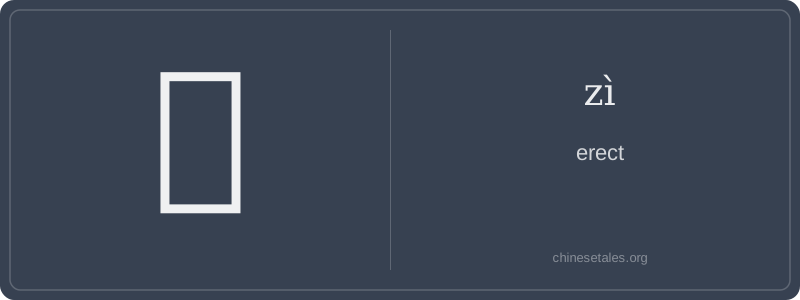
The earliest form of 剚 appears in bronze inscriptions (c. 1000 BCE) as a striking compound: a dagger-like blade (the top component, later evolving into the radical 刂) piercing downward into a simplified representation of earth or a base (the bottom part, resembling 口 or 田). This wasn’t abstract — it depicted the literal act of driving a stake, post, or weapon vertically into ground to mark territory, erect a standard, or secure a structure. Over centuries, the ‘earth’ element standardized into 止 (zhǐ, 'to stop'), while the blade sharpened into the modern 刂 (knife radical), preserving the visceral image of forceful insertion.
By the Warring States period, 剚 had shifted from concrete action ('to drive in') to abstract quality ('upright, unyielding'), especially in philosophical texts describing moral stance — e.g., Mencius uses related forms to praise ministers who 'stand firm as a blade planted in stone'. Its visual logic remains potent: the knife radical isn’t decorative; it signals that this uprightness isn’t passive — it’s *installed*, *asserted*, and carries the latent energy of the act that created it. That’s why classical poets chose 剚 over 立 when describing a cliff face — not just 'standing', but *thrust* skyward.
Let’s be honest: 剚 (zì) is a linguistic ghost — it’s real, it’s in the dictionary, and it means 'erect' or 'upright', but you’ll almost never hear it spoken or see it written outside classical texts or scholarly footnotes. Its core feel isn’t physical posture like 立 (lì, 'to stand') or 直 (zhí, 'straight'), but rather a poetic, almost architectural sense of vertical integrity — as if something has been deliberately *planted* upright with force and finality, like a pillar driven into earth. It carries quiet authority, not just position.
Grammatically, 剚 is nearly extinct as a standalone verb in modern Mandarin. You won’t say '他剚着' — that would sound archaic or nonsensical. Instead, it survives exclusively in literary compounds (e.g., 剚立, 剚然), where it intensifies the idea of unwavering uprightness — often describing mountains, moral resolve, or ancient monuments. Think of it like the English word 'hight' — technically valid, etymologically rich, but functionally reserved for Shakespearean pastiche.
Culturally, 剚 reveals how Chinese lexical precision once valued subtle distinctions in verticality: 立 is neutral standing; 植 implies planting (roots + intention); 剚 adds an edge — a sharp, decisive, even slightly violent act of fixing something upright. Learners mistakenly treat it as a synonym for 立 or 直, but doing so breaks stylistic register — like using 'whence' in a text message. Its rarity isn’t accidental: it faded because language streamlined; what was once a nuanced tool became a fossilized accent mark on meaning.