剕
Character Story & Explanation
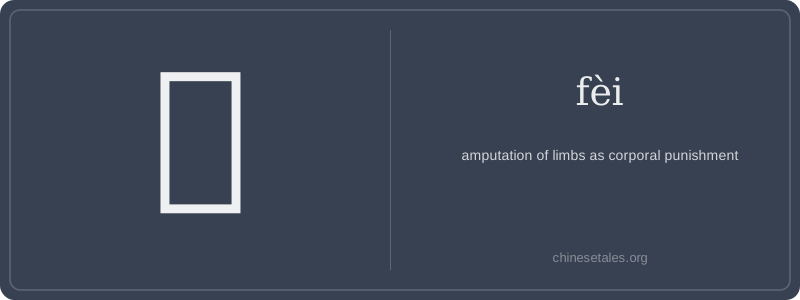
The earliest known form of 剕 appears on late Shang oracle bones and Western Zhou bronzes—not as a single unified character, but as a composite: a hand radical (, later evolving into 刂 ‘knife’) combined with a phonetic element resembling ‘費’ (fèi), which originally depicted a person kneeling beside a vessel, implying ritual expenditure or cost. Over centuries, the kneeling figure simplified; the vessel morphed into the ‘弗’ component (meaning ‘not’ or ‘to obstruct’), while the knife radical stabilized on the right. By the Qin small seal script, 剕 had crystallized into its current structure: 弗 + 刂—visually, ‘obstruction’ met with ‘blade,’ a stark glyphic metaphor for irreversible bodily negation.
This visual logic mirrored its legal function: 剕 wasn’t random violence—it was ‘ordered removal,’ a calibrated response to grave offenses like treason or repeated theft. The *Book of Rites* (Lǐjì) references it obliquely among the ‘five punishments,’ and the *Han Feizi* cites it as exemplary of early Legalist deterrence: ‘The sight of a 剕 man walking on stumps silenced a hundred would-be thieves.’ Its form—two parallel horizontal strokes in 弗 (like bound wrists) slashed by 刂—still whispers of restraint turned into erasure. No wonder it vanished from daily use once Tang and Song jurists replaced physical mutilation with exile and hard labor.
剕 (fèi) isn’t just ‘amputation’—it’s a chillingly precise term for a specific, state-sanctioned form of corporal punishment in ancient China: the deliberate cutting off of limbs (typically hands or feet) as judicial penalty. It carries none of the clinical neutrality of modern medical terms like 截肢 (jiézhī); instead, it evokes ritualized severity, moral condemnation, and the terrifying power of early legal codes. You’ll almost never hear it in spoken Mandarin today—it’s strictly literary, historical, or academic. Think of it as the Chinese equivalent of English words like ‘gibbeting’ or ‘branding’: archaic, visceral, and loaded with historical gravity.
Grammatically, 剕 functions only as a verb—and an extremely formal one at that. It’s almost always used transitively, with the limb or person as direct object: e.g., ‘剕其足’ (fèi qí zú, ‘to amputate his foot’). You won’t find it in compound verbs or aspect markers (no 剕了, no 正在剕). Learners sometimes mistakenly treat it like a noun (e.g., *‘a 剕’), but it has no nominal usage—there’s no such thing as ‘a fèi’ in Chinese. Also, avoid pairing it with modern medical subjects: saying ‘医生剕病人’ sounds absurdly anachronistic and morally jarring.
Culturally, 剕 reveals how deeply law and body were intertwined in pre-Qin thought—the body wasn’t private property but a site of social order. Its rarity today reflects Confucian humanism’s gradual triumph over Legalist severity. A common mistake? Confusing it with 刖 (yuè), another limb-amputation term—but 刖 specifically meant foot-amputation and appears in classics like the *Zuo Zhuan*, while 剕 is broader and rarer, often tied to Shang-Zhou punitive codes. If you encounter 剕, you’re reading bronze inscriptions or Han dynasty legal commentaries—not a WeChat chat.