剒
Character Story & Explanation
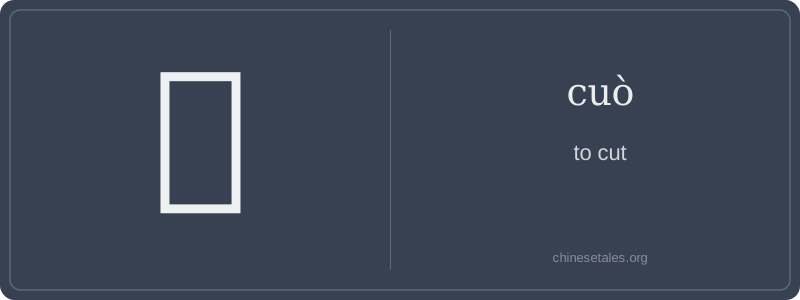
The earliest form of 剒 appears in late Warring States bronze inscriptions: a hand (扌 radical) gripping a sharp, angular blade (the right side, later standardized as 宜), poised over a horizontal line representing material to be removed—perhaps bamboo, wood, or even symbolic ‘excess’. Over centuries, the blade morphed into the complex 宜 component (originally meaning ‘suitable’, here repurposed for its sharp, cleaving shape), while the hand radical stabilized as 扌. By the Han dynasty clerical script, the structure solidified: left-hand action, right-side instrument—and the sense of *purposeful removal* was locked in.
Its meaning deepened in classical texts: in the *Zuo Zhuan*, 剒 describes trimming sacrificial offerings to ritual perfection; in Tang poetry, it evokes pruning metaphorically—‘剒去浮华’ (cut away superficial brilliance). The visual logic remains striking: the hand (扌) doesn’t hold a saw or axe, but a precise, incisive tool—echoing Confucian ideals of self-cultivation through deliberate elimination of flaws. Even today, the character’s sharp, angular strokes feel like a blade’s edge on the page.
Imagine a Tang dynasty court scribe, ink-stained fingers trembling, carefully carving bamboo slips with a sharp bronze knife—each precise, forceful stroke slicing away unwanted characters. That’s 剒 (cuò): not just ‘to cut’, but to *cut away with authority*, to excise, ablate, or prune deliberately—like editing a manuscript, removing flaws from jade, or even ritually cutting away impurity. It carries weight, intention, and finality; it’s never casual or accidental.
Grammatically, 剒 is almost exclusively literary or classical—it appears in compound verbs (e.g., 剒削 cuòxuē ‘to cut down, exploit’), passive constructions (‘be cut away’), or as a verb in parallel with other monosyllabic verbs in poetic or historical texts. You won’t hear it in daily speech: saying ‘I’ll 剒 this paper’ would sound like quoting a Song dynasty edict. Learners often misread it as cuō (like 搓) or confuse it with 切 (qiē) or 断 (duàn)—but 剒 implies *removal by incision*, not severing or chopping. Its object is always something undesirable, superfluous, or corrupt.
Culturally, 剒 echoes ancient Chinese notions of refinement: just as jade must be 剒 to reveal its true luster, moral character must be ‘cut away’ of vice. Mistaking it for common-cutting verbs leads to jarring anachronism—like using ‘hew’ instead of ‘cut’ in modern English. It survives today mostly in set phrases, scholarly writing, and classical allusions—not conversation, but conscience.