刭
Character Story & Explanation
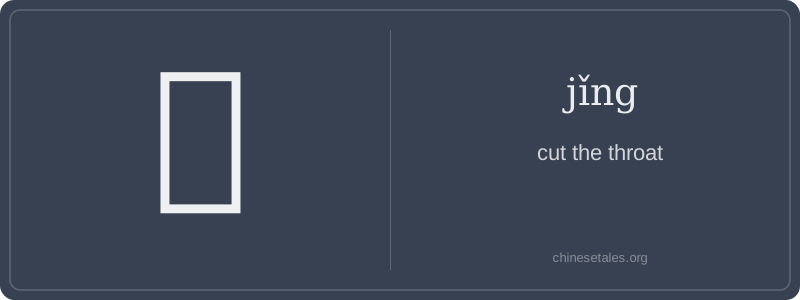
The earliest form of 刭 appears in Warring States bronze inscriptions as a composite glyph: a simplified depiction of a person (人) beside a sharp blade (刂), with an extra horizontal stroke cutting across the neck area — a stark, graphic representation of severing the carotid. Over time, the ‘person’ component evolved into 井 (jǐng, ‘well’), likely due to phonetic borrowing and scribal simplification: both 井 and 刭 share the same pronunciation and the well’s square shape visually echoed the constrained, fatal space around the throat. By the Han dynasty, the character stabilized as 井 + 刂 — seven strokes total, with the knife radical anchoring its violent semantics.
This evolution reflects a broader linguistic phenomenon: semantic drift via phonetic loan. Though 井 means ‘well’, here it serves purely for sound — a classic case of *jiǎjiè* (phonetic loan). The meaning never wavered: from oracle bone-era execution records to Tang poetry (e.g., Du Fu’s allusions to ‘首刭’ — ‘head severed at the throat’), 刭 retained its narrow, anatomical specificity. Unlike 斩 (which can mean ‘chop off head’ or even ‘cut down trees’), 刭 is unflinchingly human, unambiguously lethal, and astonishingly consistent across 2,300 years — a rare feat in Chinese character history.
Imagine a grim scene in ancient China: a disgraced general, kneeling before the emperor’s tribunal, hears the single word — jǐng. Not shouted, not whispered — just uttered with chilling finality. That one syllable doesn’t mean ‘execute’ broadly; it means *cut the throat*, specifically and surgically. 刭 is visceral, precise, and archaic — it carries the cold snap of a blade across the neck, not the bluntness of ‘kill’ or ‘behead’. It’s almost never used alone today; you’ll find it only in classical texts, historical novels, or poetic invocations of violent finality.
Grammatically, 刭 functions as a transitive verb — always requiring an object (e.g., 刭敌, 刭囚). You won’t say ‘he was 刭ed’ passively in modern speech; instead, you’d use 斩 or 处决. Learners sometimes mistakenly treat it like a generic verb for ‘kill’, but that’s dangerously inaccurate — 刭 implies immediacy, intimacy, and a certain ritualized brutality. It’s also tone-sensitive: jǐng (third tone), never jīng or jìng — mispronouncing it risks sounding like ‘well’ or ‘to fear’, which would make your sentence absurdly comic in context.
Culturally, 刭 evokes the Qin and Han dynasties’ legal severity — think of Sima Qian’s Records of the Grand Historian, where it appears in terse accounts of court punishments. Modern writers use it deliberately for stylistic gravitas: a novelist might write ‘剑光一闪,敌酋遂刭’ to conjure a flash of lethal precision. A common learner trap? Assuming it’s interchangeable with 切 (qiē, ‘to cut’) — but 切 is culinary or metaphorical; 刭 is mortal. Its rarity means it’s mostly seen in compound words or fixed phrases — never in daily conversation, and never in HSK materials for good reason.