剃
Character Story & Explanation
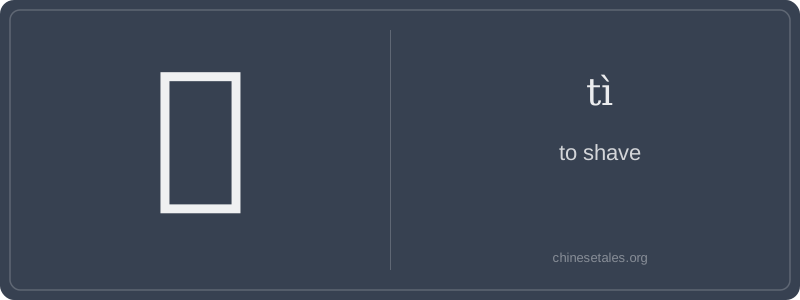
The earliest form of 剃 appears in seal script as a combination of two key elements: the left side evolved from 逇 (a variant of 易, yì, meaning ‘change’ or ‘easy’ — hinting at smooth transformation), and the right side was 刀 (dāo, ‘knife’), later standardized as the radical 刂 (the ‘knife’ radical). In bronze inscriptions, the left component resembled a stylized hand holding a tool over a head-like shape — a vivid pictograph of *cutting hair from the scalp*. By Han dynasty clerical script, the left half simplified into 弟 (dì, ‘younger brother’), purely phonetic (since 弟 and 剃 share the same ancient pronunciation *tʰejH*), while the right retained its knife identity. Today’s 9-stroke form — with the top horizontal stroke of 弟 anchoring the structure and 刂 cleanly slicing down the right — preserves that ancient sense of precision and intent.
This character’s meaning never strayed far from its visceral origin: classical texts like the *Book of Rites* (Lǐjì) mention 剃 as part of rites of passage — boys undergoing their first haircut at age nine were said to ‘receive the 剃’. Later, in Tang dynasty poetry and Ming fiction, 剃 appears in contexts of renunciation: monks ‘shaving away delusion’ (剃除烦恼). Visually, the character itself performs its meaning — the 刂 radical doesn’t just sit there; it *cuts through* the upper component, as if severing old identity. That visual violence — gentle but irreversible — is baked into every use of 剃.
At its core, 剃 (tì) isn’t just ‘to shave’ — it’s the sharp, deliberate *removal* of something unwanted from a surface: hair, stubble, even metaphorical roughness. The character feels precise and slightly clinical, carrying an undertone of control or ritual purification. Unlike generic verbs like 剪 (jiǎn, ‘to cut’) or 刮 (guā, ‘to scrape’), 剃 implies fine-tuned, close contact with a blade — think barber’s straight razor, not kitchen scissors. It’s almost always transitive and requires an object: you don’t just ‘shave’ — you 剃头 (tì tóu, shave one’s head) or 剃胡子 (tì húzi, shave one’s beard).
Grammatically, 剃 is rarely used alone; it thrives in compound verbs and nouns. You’ll hear it in imperative commands (‘Go get shaved!’ → 快去剃剃!), in passive constructions (他的头发被剃光了 — ‘His hair was completely shaved off’), and especially in fixed phrases like 剃度 (tì dù, ‘to be tonsured’ — a Buddhist ordination rite). Learners often mistakenly use 剃 where 刮 fits better: 刮胡子 is common for daily beard maintenance with a safety razor, while 剃胡子 suggests a more thorough, intentional act — perhaps before a ceremony or after long neglect.
Culturally, 剃 carries quiet weight: in traditional China, shaving the head marked profound life transitions — becoming a monk (剃度), mourning (shaving as a sign of grief), or entering military service. Even today, a man who ‘shaves his head bald’ (剃光头) signals resolve, humility, or rebellion — not just hygiene. A frequent error? Overgeneralizing 剃 to all cutting actions. Remember: if no blade is gliding *against the skin*, it’s probably not 剃.