剁
Character Story & Explanation
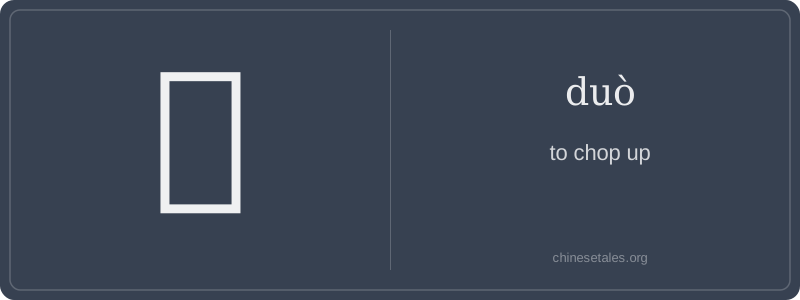
The earliest form of 剁 appears in seal script as a combination of two elements: the left side was originally 彐 (a stylized hand holding a tool), later simplified to 朵 (duǒ, 'flower bud' — purely phonetic), and the right side was 刀 (dāo, 'knife'), which evolved into the radical 刂 ('knife radical'). In bronze inscriptions, it resembled a hand gripping a blade poised over something — not a whole object, but a piece waiting to be fragmented. Over centuries, the left side shifted from 彐 to 朵 (due to sound similarity with duò), while the knife radical standardized into 刂 at the right — giving us today’s 8-stroke structure: 朵 + 刂.
This visual evolution reflects a semantic shift: from generic 'cutting with a blade' to specifically 'chopping into small pieces'. By the Tang dynasty, 剁 appears in culinary manuals describing how to prepare minced mutton for steamed buns. In the Ming novel *Jin Ping Mei*, characters '剁葱' (duò cōng, 'chop scallions') before banquets — signaling domestic labor and preparation. The character’s shape itself invites action: the 朵 suggests a cluster (like a bunch of herbs), and 刂 slices right through it — literally and graphically turning one into many.
Imagine you’re in a bustling Sichuan kitchen at 6 a.m., where a chef named Lǎo Zhāng stands over a wooden block, rhythmically *duò duò duò* — each strike of his cleaver sending fine mince flying like confetti. That sharp, percussive *duò* isn’t just ‘chop’ — it’s *chop up with force and precision*, usually into tiny, uniform pieces: garlic, ginger, pork belly, or even dried chilies for má là sauce. This character implies intentionality and texture — not just cutting, but *reducing to usable fragments*. You’ll almost never see 剁 alone; it’s always part of a verb phrase like 剁碎 (duò suì, 'chop to bits') or 剁馅儿 (duò xiànr, 'mince filling').
Grammatically, 剁 is a transitive verb that demands a direct object — you *must* say what you’re chopping up. Saying just 'I will 剁' sounds incomplete, like saying 'I will saw' without the log. Learners often mistakenly use it for general 'cutting' (like paper or hair), but that’s 切 (qiē) or 剪 (jiǎn). 剁 is visceral, culinary, and tactile — think meat, not manuscripts.
Culturally, 剁 carries the energy of northern and western Chinese cooking traditions, especially in dumpling-making rituals where families gather to 剁馅儿 together. A common error? Using 剁 for slicing vegetables thinly — no! That’s 切. Also, don’t confuse it with 砍 (kǎn, 'chop down', like trees), which conveys brute force, not culinary finesse. And yes — that *duò* sound? It’s onomatopoeic: the sharp *thwack-thwack* of steel hitting wood.