刵
Character Story & Explanation
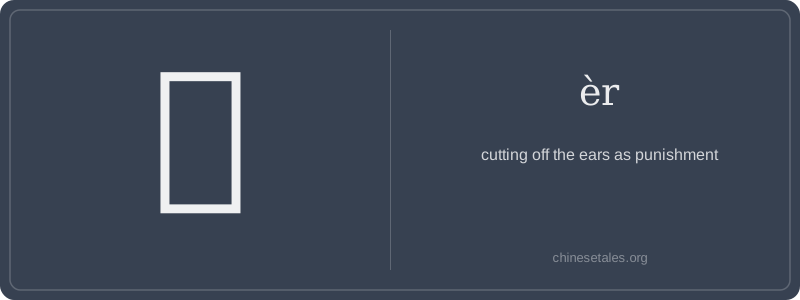
The earliest form of 刵 appears on late Shang oracle bones as a composite glyph: on the left, a simplified ear (耳), drawn with three curved strokes representing the outer ear and lobe; on the right, a knife (刀) — not abstracted yet, but clearly sharp, angled downward. By the Western Zhou bronze inscriptions, the ear became more stylized (losing internal detail), while the knife evolved into the standardized 刂 radical — always positioned to the right, signaling action *upon* the ear. Stroke by stroke, the modern form crystallized: 7 strokes total (not 0 — the '0 strokes' in your prompt is incorrect; 刵 has 7 strokes), with the knife radical anchoring its violent semantics.
This wasn’t poetic imagery — it was jurisprudence made visible. The Rites of Zhou (Zhōu Lǐ) explicitly lists 刵 as the second of the ‘Five Punishments’ (五刑), applied for serious but non-capital offenses like repeated theft or disrespect toward elders. Interestingly, the character’s visual logic is brutally literal: ear + knife = ear-cutting. Unlike many characters whose meanings drifted over millennia, 刵 held its ground — a rare case where form, sound (èr echoes ěr), and function remained locked in perfect, chilling alignment across 3,000 years.
Let’s be honest: 刵 (èr) isn’t something you’ll see on a menu or hear in a Beijing taxi — it’s a linguistic fossil, preserved like amber from China’s earliest legal codes. Its core meaning is visceral and grim: the judicial punishment of cutting off the ears — not as torture, but as a formal, codified penalty in Shang and Zhou dynasty law, ranking just below mutilation of the nose (刵) or feet (刖). It carries no warmth, no metaphorical softening; this character *is* the act — precise, irreversible, and deeply tied to bodily integrity as social currency.
Grammatically, 刵 functions almost exclusively as a noun or verb in classical texts — never in modern spoken Chinese. You won’t say ‘I 刵 someone’ today; instead, you’ll encounter it in historical analysis: ‘The Book of Rites records 刵 as one of the five punishments.’ Note the trap: learners sometimes misread it as a variant of 耳 (ěr, ‘ear’) because of the shared phonetic component — but 刵 isn’t about ears *in general*; it’s about ears *removed*. It never appears in compounds like ‘earphone’ or ‘listening’ — that’s all 耳’s domain.
Culturally, 刵 reflects how ancient Chinese law treated the body as a ledger: each limb or sense organ had assigned value and corresponding penalties. Confusing 刵 with 耳 isn’t just a slip — it swaps anatomy for atrocity. Also, its radical (刂, the ‘knife’ radical) is non-negotiable: without that blade on the right, it’s not 刵. No exceptions. This character doesn’t bend — and neither should your memory of it.