刈
Character Story & Explanation
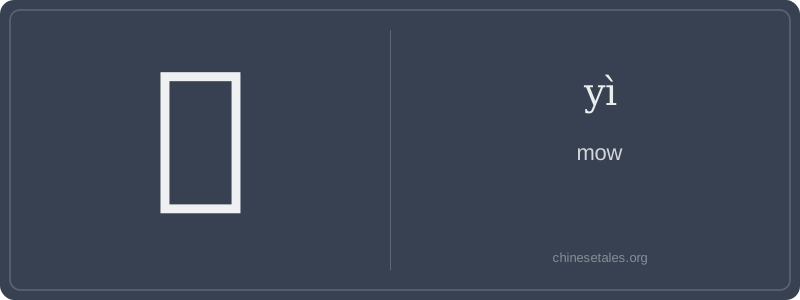
The earliest form of 刈 appears in bronze inscriptions as a pictograph showing a hand holding a curved blade over stalks of grain — a clear, kinetic image of harvesting. Over time, the grain stalks simplified into the top component 乂 (yì), which itself evolved from a cross-shaped glyph representing 'to cut across' or 'to prune'. The bottom radical 刂 (the 'knife' radical) was added later to reinforce the cutting action — not as an afterthought, but as a semantic anchor ensuring readers grasped the tool involved. By the seal script era, 乂 + 刂 had fused into the clean, four-stroke form we see today: two diagonal strokes crossing above, then the vertical knife stroke and its tiny hook — like a scythe slicing downward.
This visual logic shaped its meaning deeply: 刈 wasn’t just 'cutting', but *cutting down standing plants at the base* — a gesture tied to cyclical renewal, sacrifice, and human control over nature. In classical texts like the Zuo Zhuan, 刈 appears in metaphors like '刈其枝叶' ('cut off its branches'), symbolizing political suppression. Even today, its austerity gives it gravitas: when a poet writes 刈尽秋原, it doesn’t just mean 'mowed the autumn field' — it implies finality, silence, and the stark beauty of what remains after the blade passes.
刈 (yì) is a compact but potent verb meaning 'to mow' — specifically, to cut down grass, grain, or other low-growing vegetation with a blade. It’s not casual pruning or harvesting; it carries a sense of decisive, sweeping severance — think scythe through wheat, not shears on rosebushes. Though rare in daily spoken Mandarin (hence its absence from the HSK), it thrives in literary, agricultural, and historical contexts, often evoking classical rhythm or solemnity.
Grammatically, 刈 functions as a transitive verb and almost always takes a direct object: 刈草 (yì cǎo, 'mow grass'), 刈麦 (yì mài, 'reap wheat'). Unlike modern verbs like 割 (gē) or 收 (shōu), 刈 rarely appears in compound verbs or aspect markers (e.g., no *刈了 or *正在刈); it prefers bare form or classical constructions like 刈而藏之 ('cut and store'). Learners sometimes mistakenly use it for general 'cutting' — but 刈 never means to cut paper, hair, or meat; that’s 割, 切, or 断.
Culturally, 刈 echoes ancient agrarian life: in the Book of Songs, phrases like '七月流火,九月授衣,十月获稻,为此春酒,以介眉寿' subtly presuppose harvest actions like 刈. Modern usage leans poetic or bureaucratic — you’ll find it in official documents about farmland management or in poetry describing autumn fields. A common slip? Confusing it with 易 (yì, 'easy') — same sound, wildly different meaning and shape. Remember: 刈 has a knife (刂) — it’s sharp work, not simple work.