刃
Character Story & Explanation
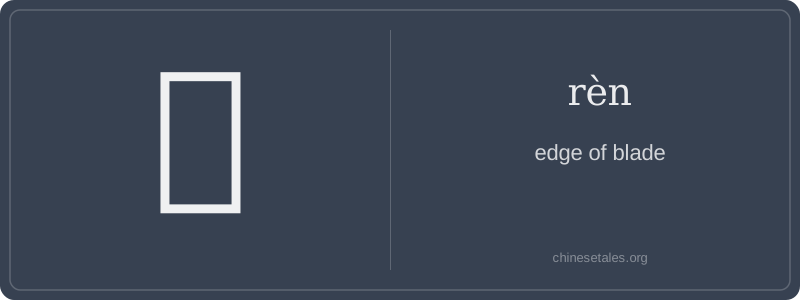
The earliest form of 刃 appears in late Shang oracle bone inscriptions as a simple, elegant pictograph: a curved blade (刀) with a single, bold dot or short stroke added precisely at the tip — like a tiny exclamation mark right where the cutting begins. That dot wasn’t decorative; it was forensic — marking the exact locus of severing power. Over centuries, the curve of the blade straightened into the modern 刀 radical (⺈), and the dot fused into a sharp, downward-flicking stroke (丶 → 丿), becoming today’s unmistakable three-stroke form: 丿 (a slashing stroke), 丶 (the original pinpoint), and 乚 (a subtle hook echoing the blade’s curve — though simplified to a mere flick in standard script).
This visual precision shaped its semantic evolution: in the *Zuo Zhuan*, 刃 appears in battlefield reports — ‘兵刃交’ (weapons’ edges met), emphasizing contact at the critical line, not the weapons themselves. By the Tang dynasty, poets used 刃 metaphorically: Li Bai wrote of ‘心刃’ (xīn rèn, ‘heart-edge’) — the mind’s capacity to pierce illusion. The character never strayed from its core idea: the singular, non-negotiable boundary between contact and cut, intention and consequence — always located, always visible, always decisive.
Imagine holding a bronze dagger from 3,000 years ago — not the whole weapon, but just the gleaming, dangerous sliver where metal meets air. That’s 刃 (rèn): not ‘knife’, not ‘sword’, but the razor-thin *edge* itself — the part that cuts, divides, and defines. It’s visceral, precise, and slightly ominous: in Chinese, 刃 carries weight beyond physics — it implies sharpness of thought, decisive action, or even moral incisiveness (e.g., in classical phrases like ‘刃见’ — ‘the edge appears’, meaning truth cuts through illusion).
Grammatically, 刃 is almost never used alone in modern speech — it’s a bound morpheme, hiding inside compound words (like 刀刃 or 剑刃) or appearing in literary or technical contexts. Learners sometimes try to use it like ‘blade’ in English (‘I sharpened the 刃’), but that’s unnatural; native speakers say ‘磨刀刃’ (sharpen the knife’s edge), never just ‘磨刃’. It’s also never a verb — unlike English ‘to edge’, 刃 never functions as an action word.
Culturally, 刃 evokes martial discipline and Daoist precision: the ‘edge’ symbolizes the moment of clarity before action — think of the swordmaster who waits until the opponent’s intent reveals itself, then strikes *at the edge* of hesitation. A common mistake? Confusing it with 刀 (dāo, ‘knife’) — but while 刀 is the tool, 刃 is its silent, lethal signature. You don’t hold a 刃; you respect its presence — like noticing the frost line on a windowpane, not the glass itself.