刂
Character Story & Explanation
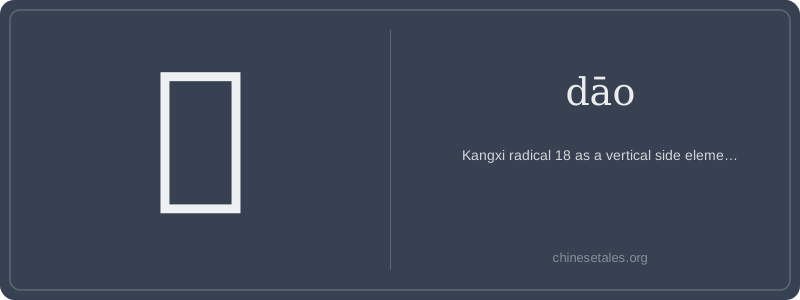
The earliest form of 刂 appears not as a separate glyph, but as the right-hand component of oracle bone inscriptions for ‘knife’—a stylized depiction of a bronze dagger with a straight blade and a hooked tip, drawn in two confident strokes. By the Zhou bronze script era, scribes began abstracting it further: the blade became a clean vertical line, and the guard or tip evolved into a distinct, downward-curving hook—essentially ‘cutting away’ all decorative detail until only function remained. This two-stroke distillation was so effective that by the Han clerical script, it stabilized into the precise, compact form we use today: a silent sentinel of sharpness, always positioned on the right.
Over centuries, 刂 never stood alone—it was always a semantic partner, lending ‘cutting’ nuance to words far beyond physical knives. In the Shuōwén Jiězì (121 CE), Xu Shen classified it as ‘Radical 18’, noting its role in characters like 刑 (punishment, originally ‘cutting off limbs’) and 列 (to array, from ‘cutting grain into rows’). Its persistence reflects a deep cultural logic: precision requires division—whether splitting bamboo strips for writing, slicing meat for ritual, or distinguishing right from wrong. Even today, when a judge ‘cuts through testimony’ (剖白), or a poet ‘carves silence’ (刻静), 刂 is there—invisibly, indispensably—in the etymology.
Think of 刂 not as a standalone character, but as Chinese writing’s version of a punctuation mark that doubles as a meaning tag—like adding an exclamation point to a verb to signal sharpness, cutting, or decisive action. It’s never used alone in modern texts; it’s always clinging to the right side of other characters (like 利, 割, or 劉), quietly whispering ‘this word involves a blade, precision, or forceful change.’ Its two strokes—a short downward stroke followed by a sharper, slightly curved hook—aren’t just minimalist art; they’re a visual shorthand for the edge of a knife held vertically, ready to slice through ambiguity.
Grammatically, 刂 doesn’t carry syntax—it carries semantics. When you see it on the right side of a character, you can bet the word relates to cutting, separating, judging, or even punishing: 判 (to judge), 刻 (to carve/engrave), or 列 (to arrange—originally ‘to cut into order’). Learners often mistakenly treat 刂 as a full character and try to pronounce it ‘dāo’ in compounds—but no: it’s silent in pronunciation; only the main component (e.g., 里 in 理) determines sound. It’s like the ‘-ed’ in English past tense: invisible in speech, but essential for meaning.
Culturally, this radical embodies a quiet violence—not of chaos, but of control: cutting grain, carving jade, drafting laws, or executing justice. Classical texts use 刂-characters to evoke moral clarity: Confucius praised the ‘sharpness’ of righteous judgment (如刀之利), while Legalist philosophers compared strict law to a well-honed blade. A common mistake? Confusing 刂 with the full character 刀 (dāo, ‘knife’)—but 刀 is a complete, independent noun; 刂 is its ghostly, grammatical echo, haunting the margins of meaning.