凼
Character Story & Explanation
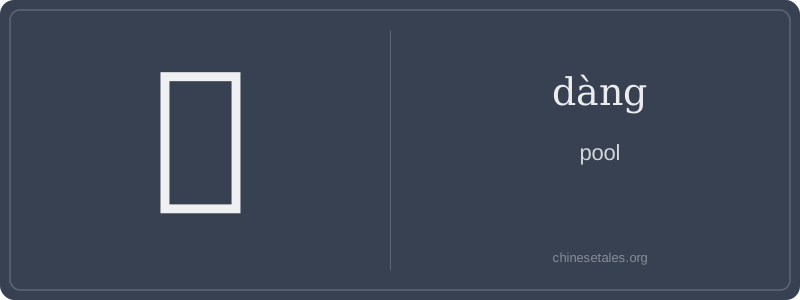
The earliest form of 凼 appears in Southern Song-era regional steles and Ming dynasty vernacular texts — not oracle bones (it’s too young for that), but as a vivid phono-semantic compound. Visually, it’s built from 水 (shuǐ, water) on the left — simplified to 氵 in modern writing — and 央 (yāng, central, middle) on the right. In bronze script variants, 央 was drawn with emphasis on enclosure: a person (亽) centered within a boundary (冂), suggesting containment. Over centuries, the water radical condensed, and 央’s strokes smoothed into today’s clean, compact shape — six strokes total: two for 氵, four for 央.
This visual logic is brilliant: water held *in the center* — a natural basin, a depression where rain gathers and stays. Classical usage is sparse, but 凼 appears in Qing dynasty Guangdong local gazetteers describing ‘山凹之凼’ (dàngs in mountain hollows) and in early 20th-century Hakka folk songs lamenting ‘晒干的凼’ (a dried-up pool) during drought. Its meaning never strayed — always a small, passive, grounded pool — unlike broader terms like 泽 (zé, marsh) or 洼 (wā, depression without water implied). The character doesn’t just name water; it names *stillness*, *containment*, and *place* — all in six strokes.
凼 (dàng) is a charmingly rustic word for a small, natural pool of water — think rainwater collected in a depression in the ground, a muddy puddle after a storm, or a shallow, still pond in a village field. It’s not formal or literary like 湖 (hú, lake) or 池 (chí, artificial pond); instead, it carries earthy, colloquial warmth — often evoking rural southern China, especially Guangdong and Fujian dialects. You’ll rarely hear it in Beijing Mandarin news broadcasts, but you’ll spot it in local signage, folk poetry, or grandparents’ stories about childhood play.
Grammatically, 凼 functions as a noun only — never a verb or adjective — and almost always appears with measure words like 一凼 (yī dàng), not 一个. It pairs naturally with verbs like 有 (yǒu, there is), 掉进 (diào jìn, to fall into), or 淌满 (tǎng mǎn, to be filled with). For example: ‘田边有一凼水’ (There’s a pool of water by the field) — note how it resists the generic 个 and demands its own cultural specificity.
Culturally, 凼 is a quiet linguistic fossil: it’s preserved in Cantonese (daang3) and Minnan dialects far more vibrantly than in standard Mandarin, where it’s nearly archaic. Learners often misread it as dàng (like 荡) or confuse it with 坑 (kēng, pit), missing its gentle, watery essence — this isn’t a dangerous hole, but a soft, reflective hollow that cradles rain. Its absence from HSK reflects how deeply regional and sensory it is: you don’t study it; you *encounter* it — barefoot, in the mud, after summer rain.