凵
Character Story & Explanation
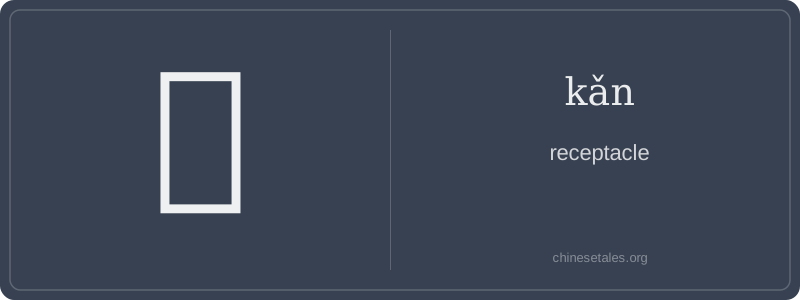
The earliest form of 凵 appears in oracle bone inscriptions (c. 1200 BCE) as a deep, U-shaped groove carved into turtle shells or ox scapulae — not for writing, but for cracking. When heated, these grooves would guide the split, revealing cracks interpreted as divine messages. The shape was unmistakable: a wide, shallow depression with gently sloping sides and a flat bottom — exactly what you’d carve to control rupture. Over centuries, the rounded groove simplified: bronze script softened the curves; seal script flattened them further; by clerical script, it became the clean, open-bottomed bracket we know — two decisive strokes: a curved downstroke followed by a firm horizontal line.
This origin explains everything. 凵 wasn’t just 'a hole' — it was *intentional hollow*, a human-made receptacle designed to receive, contain, and channel. In the Shuōwén Jiězì (100 CE), Xu Shen defines it as 'qū qiǎn yě' — 'a vessel for receiving and dispatching'. It appears in classical texts describing ritual pits for offerings (e.g., Zuǒ Zhuàn: 'wéi fēng yú kǎn', 'sacrificed within the pit'), linking its form to sacred containment. Even today, its visual grammar echoes that ancient groove: open upward, grounded below — always waiting, always holding.
Think of 凵 (kǎn) not as a 'word' you’ll use in daily chat, but as a silent architect — a foundational radical that shapes meaning from within. Its core idea is 'receptacle': something open at the top, hollow, ready to hold — like a bowl, a pit, or even a mouth. Visually, it’s just two strokes: a downward curve (㇆) and a horizontal base (一), forming an open container shape. That simplicity is its power: it doesn’t shout; it *holds space* — literally and semantically.
Grammatically, 凵 almost never stands alone in modern Chinese. You won’t find it on menus or in textbooks as an independent word — and that’s the first thing learners need to unlearn: this isn’t a vocabulary item, it’s a *structural clue*. When you see it embedded in characters like 函 (hán, 'letter/envelope'), 凶 (xiōng, 'inauspicious'), or 出 (chū, 'to go out'), it signals containment, opening, or emergence. For example, 出 is literally 'step out of a container' — the top stroke is 凵, the bottom is a foot (凵 + 丨 = 出). Miss this, and you miss the logic behind dozens of characters.
Culturally, 凵 reflects ancient Chinese spatial thinking: value isn’t just in the object, but in the *void* it creates — like the Taoist concept of 'usefulness of emptiness' (e.g., a cup is useful because of its hollow center). Learners often misread it as 'open mouth' or confuse it with 口 (kǒu, 'mouth') — but 凵 is wider, flatter, more grounded: it’s the earth’s hollow, not the face’s orifice. Its quiet presence is why calligraphers treat it with reverence — two strokes, infinite resonance.