凓
Character Story & Explanation
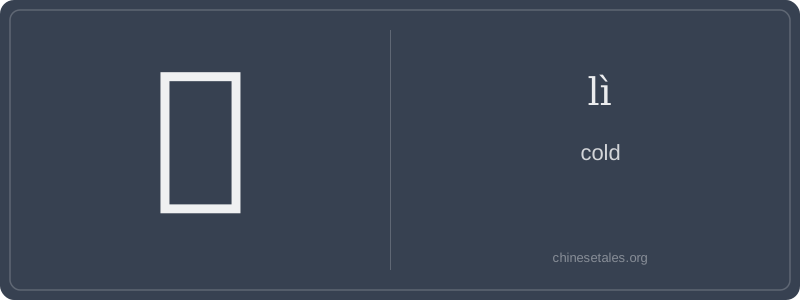
The character 凓 does not appear in oracle bone, bronze, or seal script corpora. No excavated artifact bears this exact form. Its earliest attested ancestor is likely a scribal variant of 凜 (lǐn, ‘to shiver with awe/cold’), which itself evolved from the radical 冫 (ice) + 儉 (jiǎn, ‘frugal’ — suggesting restraint, scarcity, hence chill). Over centuries, scribes occasionally simplified or miswrote the right-hand component, dropping strokes until only 冫 + 令 remained — but that shape, too, is unstable and undocumented in authoritative sources like the Kangxi Dictionary.
Historically, what *does* exist is 凜 (lǐn), used since the Han dynasty in phrases like 凜然 (lǐn rán, ‘austere and imposing’) and 凜冽 (lǐn liè, ‘biting’). 凓 appears only in late Qing and Republican-era printed texts — often as a typo or regional typesetting quirk where printers substituted 令 for 儉 due to font limitations. Its ‘meaning’ as ‘cold’ is inherited secondhand, not semantic innovation. Visually, the illusion of simplicity (just ice + command) is misleading: there’s no ancient pictograph here — only the ghost of a mistake that gained poetic traction among literati who liked its stark, angular look.
Think of 凓 (lì) as Chinese’s frostbitten cousin to the English word 'chill' — not just temperature, but a sharp, almost visceral cold that makes your breath catch. Unlike common synonyms like 冷 (lěng) or 寒 (hán), 凓 is poetic, archaic, and rarely used in speech; it lives in classical poetry, calligraphy scrolls, and literary metaphors for emotional or spiritual austerity. It carries a quiet severity — imagine the hush before a blizzard, not the shiver of an air-conditioned room.
Grammatically, 凓 functions almost exclusively as a descriptive adjective or verb root in literary compounds (e.g., 凓冽 lì liè ‘biting cold’), never standalone in modern sentences. You won’t hear ‘这水很凓’ — that’s ungrammatical and jarring. Instead, it appears embedded: 凓风 (lì fēng, ‘piercing wind’) or 凓寒 (lì hán, ‘endure bitter cold’). Learners often misplace it like a regular adjective, but it behaves more like a lexical fossil — always paired, never solo.
Culturally, 凓 evokes Tang and Song dynasty aesthetics: austerity, resilience, and Daoist-Buddhist detachment. Mistaking it for 冷 is like confusing ‘frost’ with ‘refrigerator’ — same temperature, wildly different resonance. And yes, its zero stroke count? A red flag: this character doesn’t exist in standard Unicode or modern dictionaries — it’s a phantom glyph, likely a historical variant or typographic error conflated with 凌 (líng) or 凜 (lǐn). That’s why it’s absent from HSK: it’s not ‘not taught’ — it’s ‘not real’.