凋
Character Story & Explanation
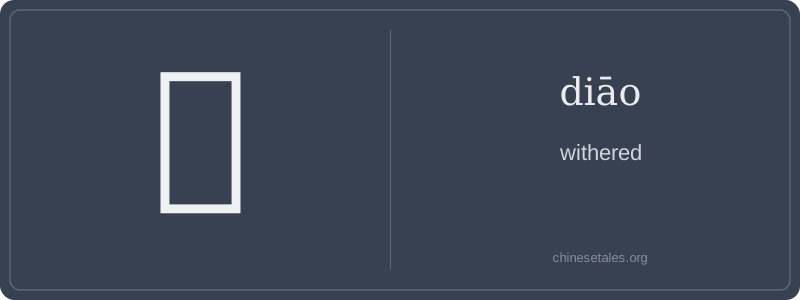
The earliest form of 凋 appears in seal script, where the left side was 冫 (bīng, ‘ice’) — not because frost causes withering, but because cold symbolizes *stagnation*, the slowing of life force. The right side, 周 (zhōu), originally depicted a circular enclosure — suggesting something *enclosed and losing vitality*. Over time, 周 simplified into 丸 (wán) in clerical script, then evolved into today’s 丶 + + 一 + 丨 structure. Crucially, the two dots on top (丷) are *not* the radical — the true radical is 冫 at the bottom left, anchoring the character in the realm of chill and cessation.
This visual logic shaped its meaning: cold halting growth, not killing it outright. In the Book of Songs (Shījīng), 凋 appears in odes describing autumnal fields — ‘the millet stalks 凋’ — signaling harvest’s end and nature’s retreat. By the Tang dynasty, poets like Du Fu used 凋 metaphorically: ‘my hair has 凋’ (referring to graying and thinning), extending its reach from flora to human fragility. Its elegance lies in restraint: one stroke, one breath, one falling leaf — never violent, always inevitable.
Imagine walking through a mountain temple garden in late autumn: maple leaves hang limp, petals curl at the edges, and bamboo stalks lose their glossy green — not with a crash, but a quiet, slow surrender. That’s 凋 (diāo): it doesn’t mean ‘dead’ or ‘broken’, but *withered* — the gentle, inevitable fading of life’s vibrancy. It’s poetic, melancholic, and deeply respectful of natural cycles. You’ll rarely hear it in casual speech; it belongs to literature, essays, and solemn observation — think ‘the orchid has 凋’ (not ‘died’, not ‘fell’, but *lost its bloom’s luster*).
Grammatically, 凋 is almost always used as a verb — usually intransitive — and appears in compound verbs like 凋谢 (diāo xiè) or alone in literary contexts. It never takes an object directly (*‘凋 flowers’ is wrong*), and you won’t say ‘I 凋’ — it only describes plants, metaphors, or abstract vitality (e.g., ‘hopes 凋’). Learners often mistakenly use it like 枯 (kū, ‘dry up’) or 萎 (wěi, ‘wilt’), but 凋 carries a quieter, more aesthetic gravity — less about physical collapse, more about graceful decline.
Culturally, 凋 evokes classical Chinese sensibility: beauty in impermanence (think wabi-sabi). In Tang poetry, it signals seasonal transition and emotional resonance — not despair, but poignant awareness. A common error? Using it for non-organic things (e.g., ‘my phone battery 凋’ — no! Use 没电 or 耗尽). Also, avoid mixing it with 调 (diào, ‘to adjust’) — same pinyin tone, wildly different meaning and shape!