凅
Character Story & Explanation
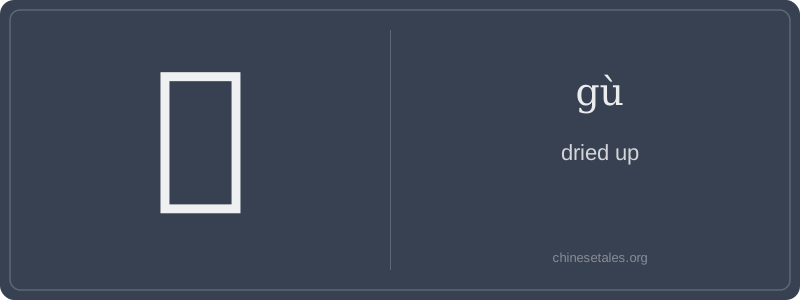
The earliest form of 凅 appears in Warring States bamboo slips—not as a pictograph, but as a phono-semantic compound: the left side 冫 (bīng, 'ice') hints at cold-induced drying, while the right side 固 (gù) serves both as sound clue and semantic reinforcement ('firmness' implying irreversibility). Its oracle bone roots are lost, but bronze inscriptions show 冫 + 固 fused into a tight, angular shape: two icy dots above a dense, unyielding frame—visually echoing how water vanishes under frost or drought until only rigid, hollow contours remain.
By the Han dynasty, 凅 appeared in texts like the *Huainanzi*, describing rivers '凅于夏' ('dried up in summer')—not just lacking water, but transformed into brittle, lifeless terrain. Its meaning sharpened over centuries: where 枯 suggests gradual withering (like a dying plant), 凅 implies sudden, total desiccation—often due to extreme cold or prolonged absence. The character’s visual austerity mirrors its semantic austerity: no flourish, no ambiguity—just absolute dryness, sealed like ice in a forgotten well.
Imagine a cracked, sun-baked riverbed—no water, no life, just brittle earth sighing in the heat. That’s the visceral feeling of 凅 (gù): not merely 'dry,' but utterly desiccated, drained beyond recovery. It’s a literary, almost poetic word—not for your morning coffee cup left out overnight, but for ancient wells gone silent, inkwells frozen in winter, or metaphors for emotional exhaustion. You’ll rarely hear it in casual speech; it lives in classical allusions, poetic descriptions, and formal writing.
Grammatically, 凅 functions as a stative verb (like 'to be dried up') or an adjective ('dried-up'), often appearing after 被 (bèi) in passive constructions or paired with nouns like 河 (river), 墨 (ink), or 心 (heart). Unlike common verbs like 干 (gān) or 枯 (kū), 凅 carries finality—it implies irreversible loss of moisture or vitality. Learners sometimes misread it as 固 (gù, 'firm') due to identical pronunciation and similar stroke density, but that’s a classic trap: saying 'the well is 固' would mean 'the well is solid'—not quite what you meant!
Culturally, 凅 evokes Daoist and classical imagery of entropy and stillness—think of Zhuangzi’s meditations on dried-up ponds where fish gasp for memory of the sea. It’s also used ironically in modern satire: '他热情已凅' ('His enthusiasm has dried up') sounds elegantly tragic, even when describing someone bored by a Zoom meeting. Avoid using it in beginner-level speech—but savor it like aged wine when crafting precise, resonant language.