冽
Character Story & Explanation
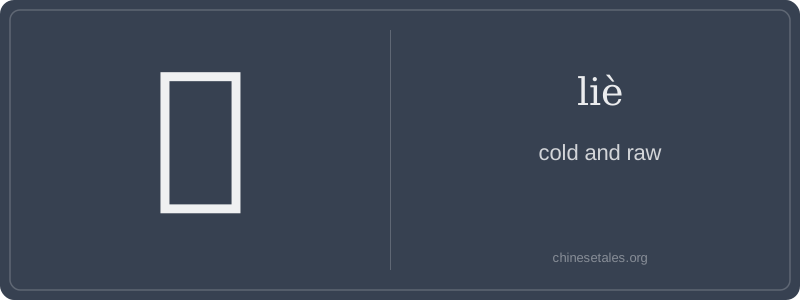
The earliest form of 冽 appears in bronze inscriptions as two ice crystals (冫) beside a phonetic component that evolved into 列. The left side 冫 (bīng) — the ‘ice’ radical — was always the semantic anchor, visually anchoring coldness. The right side 列 originally depicted a divided arrangement (like cut pieces lined up), but here it served purely as a sound clue — its pronunciation liè matched the target word. Over centuries, the character streamlined: the top stroke of 列 simplified, and the two dots of 冫 became distinct, crisp, and slightly tilted — like frost crystals catching light.
This visual duality — ice + line — subtly echoes its meaning: cold so sharp it feels *ordered*, almost architectural in its severity. By the Han dynasty, 冽 appeared in texts like the Shuōwén Jiězì as ‘cold that pierces’, used for mountain winds and mountain springs alike. Its enduring pairing with 凛 (lǐn, ‘stern, awe-inspiring’) in 凛冽 captures how Chinese conceptualizes extreme cold not just physically, but emotionally — as something that commands reverence, even fear. The character doesn’t just describe chill; it evokes the hush before snowfall, the stillness after a storm — a cold that silences and clarifies.
冽 isn’t just ‘cold’ — it’s the bone-deep, wind-scoured cold of northern China in deep winter: raw, sharp, and almost tactile. Think of stepping outside at dawn when frost cracks underfoot and your breath hangs like shattered glass. In Chinese, 冽 rarely stands alone; it’s almost always paired (e.g., 凛冽, 清冽) to intensify sensation — not temperature alone, but the *quality* of cold: its clarity, its bite, its purity. This reflects a linguistic habit deeply rooted in Chinese aesthetics: meaning is often layered through compound resonance, not isolated definition.
Grammatically, 冽 functions exclusively as a descriptive morpheme — never as a verb or noun. You’ll never say ‘the wind 冽s’; instead, it modifies nouns or completes adjectival phrases: ‘凛冽的北风’ (biting north wind), ‘清冽的泉水’ (crisp, pure spring water). Learners sometimes mistakenly use it like English ‘cold’ — as a standalone predicate adjective — but 冽 has no independent copular use. It’s a flavor enhancer, not the main course.
Culturally, 冽 carries poetic weight: classical poets used it to evoke moral austerity (e.g., ‘凛冽之气’ — the aura of unyielding integrity) or natural purity untouched by human artifice. Modern usage leans literary or descriptive — common in weather reports, wine tasting notes, or scenic writing. A frequent slip? Confusing it with 列 (liè, ‘to line up’) due to identical pinyin — but their radicals (冫 vs. 刂) and meanings are worlds apart. Remember: 冽 chills your nose; 列 organizes your grocery list.