冶
Character Story & Explanation
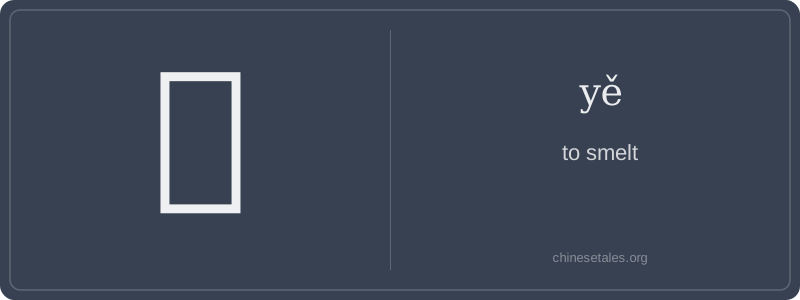
The earliest form of 冶 appears in late Shang oracle bone inscriptions as a pictograph combining two key elements: a simplified representation of ‘ice’ or ‘cold’ (冫, the radical we see today) and a phonetic component resembling ‘易’ (yì, ‘easy’ or ‘change’) — but crucially, in bronze script, the right side looked more like a stylized crucible with rising steam or flame. Over centuries, the ‘ice’ part solidified into the left-side 冫 radical (though ironically, smelting requires intense heat — more on that soon), while the right evolved from a complex vessel-and-flame glyph into the streamlined 易 shape we write today — a classic case of phonetic simplification masking original meaning.
Here’s the delightful paradox: though 冫 usually signals cold (as in 冰 bīng, ‘ice’), 冶 is all about fire and heat. Scholars believe the ‘ice’ radical was borrowed not for meaning, but for sound — early pronunciations of 冶 and 冰 may have shared phonetic features in Old Chinese. By the Warring States period, 冶 was firmly established in texts like the *Guanzi* to describe state-controlled metal production, linking technological power to political authority. The character’s visual tension — cold radical + hot action — mirrors ancient China’s philosophical balance: even fire must be disciplined, cooled, and controlled to forge something enduring.
Imagine a blazing Bronze Age furnace in ancient Shang dynasty Anyang: molten copper and tin bubbling under intense heat, workers stirring with long ladles, smoke rising into the twilight — that’s 冶 (yě) in action. This isn’t just ‘to melt’; it’s *controlled transformation* — raw ore becoming refined metal, chaos made useful through skill and fire. In modern usage, 冶 carries that weight of deliberate, expert change: you don’t ‘冶’ water or ice — only stubborn, resistant materials like metals and ores. It’s almost exclusively used in formal, technical, or literary contexts: metallurgy textbooks, historical novels, or official reports on industrial policy.
Grammatically, 冶 is almost never used alone as a verb in spoken Mandarin — you won’t hear someone say ‘我冶铁’ in daily conversation. Instead, it appears in compounds (like 冶炼 or 冶金) or as the verb in tightly structured written phrases: ‘冶铸青铜器’ (to smelt and cast bronze vessels), where it pairs naturally with other classical verbs. Learners often mistakenly use it like 熔 (róng, ‘to melt’) — but 冶 implies human agency, technology, and purpose, while 熔 is passive, physical change (e.g., ice melting in sun). Using 冶 for ‘melting chocolate’ would sound hilariously anachronistic — like describing your microwave as a Shang dynasty foundry.
Culturally, 冶 embodies China’s early mastery of high-temperature chemistry: the world’s first cast iron (5th c. BCE) was produced using precisely this process. That legacy lives on in terms like 冶金学 (yějīn xué, ‘metallurgy’) — a field where precision, tradition, and innovation fuse, much like the metals themselves. Don’t force 冶 into casual speech; let it shine where expertise and transformation meet.