冱
Character Story & Explanation
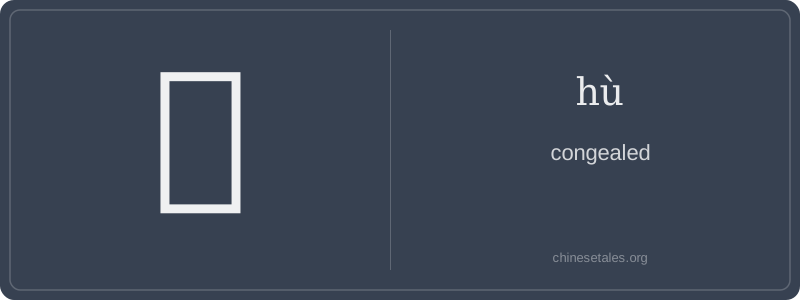
The earliest form of 冱 appears in bronze inscriptions as two parallel horizontal strokes (like frozen ripples) above a simplified 'person' or 'vessel' shape — depicting water surface rigidly locked under ice. Over time, the 'person' element vanished, and the top evolved into the standard ice radical 冫 (two dots + downward stroke), while the bottom condensed into the phonetic component 互 (hù), which originally depicted interlocked tools — suggesting 'mutual binding', perfectly mirroring how ice binds water molecules. By the Small Seal Script, the character stabilized into its modern six-stroke form: 冫 + 互.
This visual logic became semantic truth: 冱 doesn’t mean 'cold' — it means 'bound by cold'. In the Shuōwén Jiězì (121 CE), Xu Shen defined it as 'water frozen so solid no flow remains', linking it to seasonal cessation in agricultural almanacs. Classical poets like Du Fu used it to evoke existential stasis — 'the river 冱, the road silent' — where physical freezing mirrors emotional paralysis. Even today, its shape whispers constraint: those two icy dots (冫) press down on the interlocking 互, like frost sealing fate.
冱 (hù) is a poetic, literary word meaning 'frozen solid' or 'congealed' — not just cold, but utterly still, sealed by ice. It evokes deep winter stillness: rivers locked under thick ice, mist frozen mid-air, even abstract things like 'frozen silence' or 'stagnant emotions'. You’ll almost never hear it in daily speech — it’s the kind of word you find in classical poetry, historical texts, or modern literary descriptions aiming for solemn, ancient resonance.
Grammatically, 冱 functions as a verb (often in compound verbs like 冱结) or an adjective (e.g., 冱寒), but crucially, it’s nearly always used *passively* — something *becomes* 冱, not someone *makes* it 冱. It rarely takes an object and almost never appears in casual imperatives or colloquial questions. Learners sometimes misread it as 'to freeze (transitively)' and try to say 'I froze the water with 冱' — but that’s impossible; 冱 describes the *state*, not the action. Think of it like 'petrified': you don’t 'petrify' something with petrified — it *is* petrified.
Culturally, 冱 carries a quiet, almost metaphysical weight — it suggests finality, suspension, and natural inevitability. In classical texts like the Zuo Zhuan, it appears in seasonal records ('the river has 冱'), marking climatic turning points. Modern writers use it sparingly for atmospheric gravitas — overusing it sounds archaic or pretentious. A common learner trap is confusing its radical 冫 (ice) with 氵 (water) — but 冱 isn’t about flowing or wetness; it’s about *arrested motion*. Its rarity means it’s often mispronounced as hú or hǔ — remember: the 'ù' is a falling tone, like a sigh of icy resignation.