冢
Character Story & Explanation
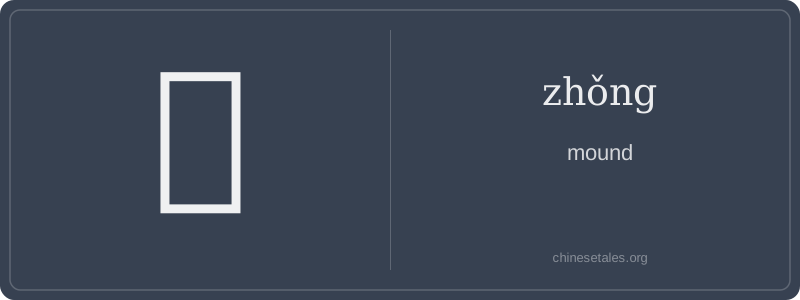
The earliest form of 冢 appears in bronze inscriptions as a stylized mound with a covering — imagine a low, rounded hill topped by a cloth or canopy, rendered as a horizontal line above two stacked strokes representing piled earth. Over centuries, the top evolved into the radical 冖 (mì), meaning 'cover' or 'canopy,' while the lower part solidified into 家 without the 'pig' (豕) — wait, no! Actually, the bottom is 乇 (tuō), a phonetic component, but scribes gradually miswrote it as 家’s topless form, giving rise to the modern shape: 冖 (cover) + 家 (without 豕) = a covered, domesticated earth — i.e., a human-made burial mound, not a natural hill.
This visual logic held firm: the 'cover' radical signals ritual containment; the lower part hints at settlement, lineage, and permanence. By the Han dynasty, 冢 was standard for imperial and aristocratic tombs — distinct from 坟 (fén), which could be humble. The Classic of Poetry mentions ‘冢墓累累’ (zhǒng mù lěi lěi, 'mound upon mound'), and Sima Qian used 冢 to describe Confucius’s tomb — already then, it carried gravitas. Even today, seeing 冢 in a text is like spotting a weathered stone stele: you know you’ve entered a space of memory, not geography.
Think of 冢 (zhǒng) not as a generic 'mound' but as a *deliberately constructed, solemn mound* — specifically, an ancient burial mound or tumulus. It carries weight, reverence, and historical gravity; you won’t use it for a molehill or a sand dune. Its core feeling is 'monumental earth over the dead' — quiet, dignified, and slightly archaic. In modern usage, it appears almost exclusively in literary, historical, or poetic contexts, never in casual speech: you’ll see it in phrases like ‘荒冢’ (huāng zhǒng, 'desolate grave mound') or names of famous tombs, but never in ‘my backyard mound.’
Grammatically, 冢 functions only as a noun — never a verb or adjective — and almost always appears in compound words, rarely alone. Learners sometimes try to use it like 土堆 (tǔ duī, 'pile of earth'), but that’s a major faux pas: 冢 implies ritual, memory, and time — not just dirt. Also, note its tone: zhǒng (third tone), not zhōng (first) — confusing it with 中 would be like saying 'mound' when you mean 'middle.'
Culturally, 冢 evokes China’s deep tomb culture: from the massive mounds of Han dynasty nobles to Du Fu’s melancholy line ‘冢上草青青’ ('green grass grows thick on the grave mound'). Mistake it for 坟 (fén, 'grave') and you’ll sound overly classical; confuse it with 丘 (qiū, 'hill') and you’ll erase all funerary meaning. It’s a character that whispers history — so listen closely.