冞
Character Story & Explanation
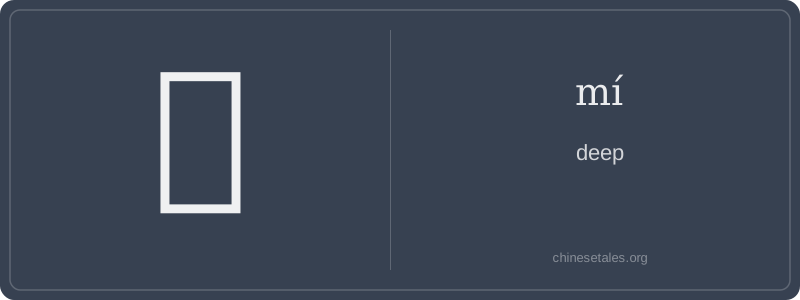
Carved onto late Shang oracle bones, 冞 began as two parallel horizontal lines — representing water layers — beneath a stylized ‘cover’ glyph (冖, the ‘roof’ radical), suggesting something enclosed *beneath successive strata*. Over centuries, the upper cover solidified into the modern 冖, while the dual horizontals thickened and aligned into the two stacked strokes below — not random lines, but deliberate strata: first layer, second layer, *deeper still*. By the Qin bamboo slips, it had stabilized into its current form: 冖 + 二 — a roof over duality, evoking depth through layered containment.
This visual logic shaped its meaning: not mere vertical distance, but *cumulative immersion*. In the Classic of Poetry (Shījīng), 冞 appears in odes describing ‘the ever-deepening dusk’ — not just darker, but *denser* with quiet. Later, in Tang poet Wang Wei’s landscape verses, 冞深 describes mountains where mist doesn’t just cover peaks but *settles, thickens, and absorbs light*. The character’s structure — a covering above two levels — mirrors how Chinese thought conceives depth: not as emptiness, but as rich, layered presence. Its rarity today isn’t decline — it’s preservation, like a sealed scroll holding concentrated resonance.
Here’s the truth no textbook tells you: 冞 isn’t just ‘deep’ — it’s *profoundly* deep, the kind of depth that makes you pause mid-sentence. In classical Chinese, it conveys an almost metaphysical intensity — not merely physical depth (like a well), but depth of feeling, insight, or time. Think of the hush before thunder, or the silence after a master’s teaching sinks in. Modern usage is rare and literary; you’ll almost never hear it in daily speech or see it in HSK materials — it lives in poetry, calligraphy inscriptions, and scholarly essays.
Grammatically, 冞 functions as an adverb, often prefixed to adjectives or verbs to amplify degree: 冞加 (mí jiā, ‘increasingly more’), 冞深 (mí shēn, ‘ever deeper’). It never stands alone like 深 (shēn); it’s always a booster, like ‘ever-’ or ‘evermore-’ in English. Learners mistakenly try to substitute it for 深 in phrases like ‘deep water’ — but 冞 + noun? Not allowed. It only modifies verbs/adjectives, and only in formal, elevated registers.
Culturally, 冞 reflects the Chinese aesthetic of *subtle intensification*: valuing layered meaning over blunt repetition. Using 冞 signals reverence — for tradition, for emotion, for nuance. A common mistake is misreading it as 深 due to visual similarity, but doing so strips away centuries of tonal gravity. It’s not obsolete — it’s *curated*. You’ll find it on antique scrolls, in Tang dynasty poems, and in the quiet pride of a calligrapher who chooses it not because it’s easy, but because it’s *right*.