冘
Character Story & Explanation
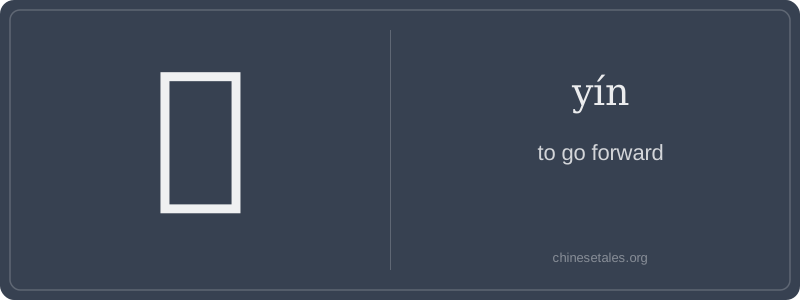
The earliest form of 冘 appears in late Shang oracle bone inscriptions as a simple, elegant glyph: a downward-sloping line (representing a path or direction) topped by a small horizontal stroke — like a traveler stepping off a threshold. Over centuries, the top stroke evolved into the covering radical 冖 (a symbolic canopy or shelter), while the descending stroke became more angular, eventually stabilizing into the modern four-stroke form: 冖 + 丿. Crucially, this wasn’t a picture of a person walking — it was a *directional marker*, pointing forward under protection or auspice, suggesting sanctioned, legitimate advance.
In the Warring States bamboo texts and early dictionaries like the Shuōwén Jiězì (121 CE), 冘 was defined as 'to proceed' (行也), but always with connotations of propriety and sequence — moving forward *in order*, not impulsively. Confucian commentaries subtly employed it to describe the moral progression of self-cultivation: one doesn’t rush virtue, but 冘 toward it, step by measured step. Its visual minimalism — just four strokes — mirrors its philosophical function: a silent, structural nudge toward right action, not a shout of motion.
At first glance, 冘 (yín) feels like a linguistic ghost — it’s ancient, rare, and almost never used alone in modern speech or writing. Its core meaning 'to go forward' isn’t about motion in space (like 走 or 前进), but about *inner momentum*: advancing a thought, proceeding with intention, or pushing an action forward in a formal, almost ritualistic sense. Think of it as the quiet hum of resolve before a decision is spoken aloud — deeply Chinese in its emphasis on deliberate, unshowy progress.
Grammatically, 冘 appears almost exclusively within compound words or classical set phrases — never as a standalone verb. You’ll find it in literary or bureaucratic contexts: 冘余 (yín yú, 'superfluous') literally means 'excess that has gone too far forward', and 冘长 (yín cháng, 'protracted') implies time or process stretching *beyond* what’s appropriate — again, that subtle nuance of forward motion crossing into excess. Learners mistakenly try to use it like 行 or 进, but 冘 carries no colloquial energy; it’s a fossilized particle of classical syntax, not a working verb.
Culturally, 冘 reveals how Chinese conceptualizes 'forward' not just spatially, but ethically — movement must be measured, purposeful, and socially calibrated. Its near-total absence from daily language (and the HSK!) underscores a profound truth: some ideas are so foundational they become invisible, embedded only in compounds where their weight still quietly shapes meaning. Mistake it for 冗 (rǒng), and you’ll misread bureaucratic documents — a tiny stroke difference that flips 'excess' into 'redundancy' with legal consequences.