冗
Character Story & Explanation
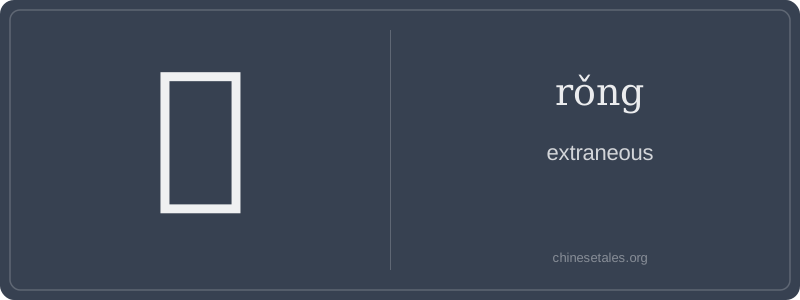
Look closely at 冗: just four strokes — a downward stroke (丶), a horizontal stroke (一), a left-falling stroke (丿), and a final dot-like hook (乀). Its earliest form in bronze inscriptions (c. 1000 BCE) was even simpler: a stylized depiction of *a person with exaggerated, flapping sleeves* — not dancing, but *waving away unnecessary things*. Over centuries, the figure shrank and abstracted: arms became the two diagonal strokes, the body condensed into the top dot and horizontal line, and the radical 冖 (a 'cover' or 'hood') settled on top — suggesting something *covered up, hidden, yet still visibly excessive*. By the seal script era, it had crystallized into today’s minimalist shape.
This visual origin directly shaped its meaning: what’s flapping, uncontrolled, and covering more than needed? *Superfluity*. In classical texts like the *Zuo Zhuan*, 冗 appears in critiques of verbose diplomacy — '冗辞' (rǒng cí, 'extraneous words') — where brevity signaled wisdom and authority. Even Confucius, though he never used 冗 directly, praised '言之无文,行而不远' ('speech without elegance travels not far'), implicitly condemning 冗. The character’s power lies in this irony: its own form is lean and efficient — a perfect vessel for naming inefficiency.
Think of 冗 (rǒng) as the linguistic equivalent of a cluttered desk — it’s all about *unnecessary excess*. Its core meaning — 'extraneous', 'superfluous', 'redundant' — isn’t abstract jargon; it’s deeply tactile in Chinese. Native speakers feel 冗 as *visual and textual weight*: a sentence with 冗 characters drags; a speech full of 冗 phrases bores; even clothing can be 冗 — think overly layered, fussy, or needlessly ornate. It’s never neutral: 冗 always carries mild disapproval, like spotting an extra comma that serves no grammatical purpose.
Grammatically, 冗 is almost exclusively an adjective — but crucially, it *never stands alone*. You won’t say 'this is 冗'; you’ll say 冗长 (rǒng cháng, 'tediously long'), 冗余 (rǒng yú, 'redundant'), or 冗杂 (rǒng zá, 'cluttered/messy'). It’s a team player, always paired — and usually before a noun or another descriptive character. Learners often mistakenly try to use it predicatively ('The report is 冗') — but native speakers would say '这份报告很冗长' (zhè fèn bàogào hěn rǒng cháng), using the compound + 很. That ‘very’ is your safety net!
Culturally, 冗 reflects a deep-rooted Chinese aesthetic value: elegance through restraint. In calligraphy, poetry, and even bureaucracy, concision is virtue — and 冗 is its foil. A common mistake? Confusing it with 宂 (a rare variant) or misreading it as 內 (nèi, 'inside') due to the shared 冖 radical. But 冗’s four strokes are stark, minimal, and ironically *perfect* — a tiny character carrying a huge critique of excess.