冖
Character Story & Explanation
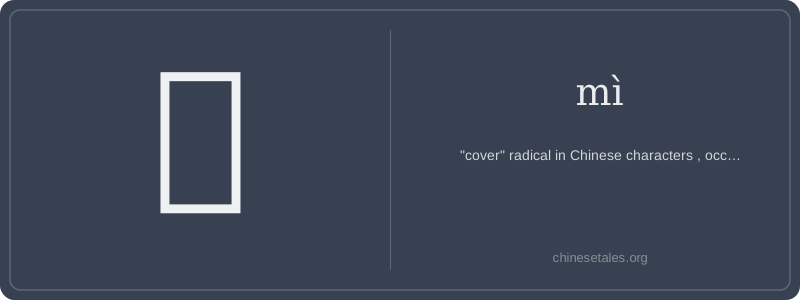
Carved over 3,000 years ago on oracle bones, 冖 began as a pictograph of a cloth or animal hide draped over a vessel — a simple, elegant arc representing something placed deliberately *over* an object to cover, protect, or consecrate it. Early bronze inscriptions preserved this curve, sometimes with a tiny dot or line underneath to indicate what was covered. Over centuries, the stroke simplified: the original fluid arc hardened into a clean, downward-sweeping stroke (㇇), then the second stroke — a short horizontal or slightly tilted line (一) — emerged to reinforce the idea of closure at the base. By the Small Seal Script era, it had stabilized into its modern two-stroke form: no frills, no flourishes — just coverage made visible.
This visual economy mirrored its semantic evolution: from literal covering (a lid, a shroud) to metaphorical encompassing — authority (as in 軍), dignity (in 冠), and even the metaphysical veil between life and death (in 冥). Confucian texts later echoed this: the ‘covered’ state implied order, restraint, and proper placement — just as a well-fitted crown signifies rightful rule. The character’s silence — its refusal to stand alone — is itself a lesson: in Chinese, some meanings only exist in relationship, held gently, but firmly, from above.
Think of 冖 (mì) not as a standalone word you’ll use in conversation, but as a quiet architect — the 'cover' radical that silently shapes meaning from above. Its two strokes form a soft, downward curve: a gentle roof, a draped cloth, or even a protective hand hovering over what’s beneath. In characters like 軍 (jūn, 'army'), it visually shelters the lower component (車, 'chariot'), suggesting 'troops gathered under command' or 'forces assembled under one banner.' It’s never used alone in modern writing — it’s pure structural poetry.
Grammatically, 冖 is never a word, so you won’t conjugate it or put it in sentences directly. But when you see it perched atop characters like 冠 (guān, 'crown') or 冥 (míng, 'darkness'), it signals containment, covering, or concealment — often with a sense of authority or profundity. Mistake alert: learners sometimes misread it as the 'lid' radical 宀 (mián), which also means 'roof' but has a distinct three-stroke shape and appears in houses (家, 安). 冖 is leaner, simpler, and far more ancient.
Culturally, this radical carries the weight of ritual and hierarchy: a crown covers the head (冠), an army gathers under unified command (軍), darkness envelops the unseen (冥). Its minimalism is intentional — two strokes hold cosmic ideas: shelter, sovereignty, and the boundary between seen and hidden. Don’t try to ‘use’ 冖 — learn to *recognize* its hush, and you’ll suddenly see the logic in dozens of characters.