冔
Character Story & Explanation
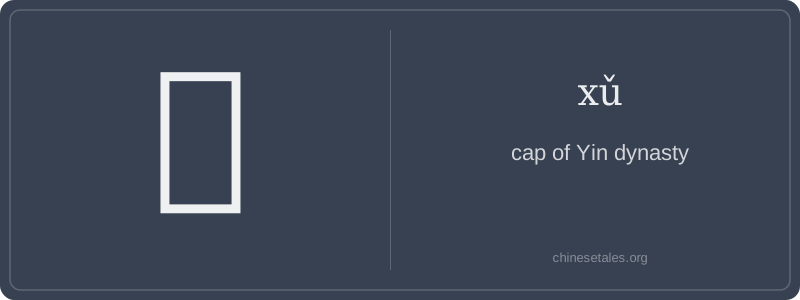
The earliest form of 冔 appears in oracle bone inscriptions as a stylized drawing of a tall, flared ceremonial cap viewed frontally: two vertical lines (representing stiffened cloth or leather bands) topped by a broad, curved brim—like a flattened ‘U’ over a stem. Bronze script simplified this into three key strokes: the top curve (⺈), the central vertical line (丨), and the base horizontal support (一). Over centuries, the brim became more angular, the stem thicker, and the base evolved into the modern ‘凵’-shaped enclosure—still evoking a rigid, hollow headpiece anchored firmly on the skull.
This visual logic held firm across dynasties: in the *Book of Rites* (Lǐjì), 冔 appears in reconstructed fragments describing ‘the proper cap for the Yin duke’s libation ceremony’—always linked to hierarchy and sacred precision. Unlike generic terms like 冠 (guān, ‘crown’), 冔 specifies *only* the archaic, non-functional, ritually locked cap of the Yin elite—never worn in daily life, never passed down, never reused. Its shape, even today, whispers ‘ceremonial containment’: the character itself looks like something meant to hold reverence, not hair.
Imagine you’re holding a tiny, exquisitely cast bronze cap—no bigger than your thumb—from the Shang dynasty royal tomb at Yinxu. This isn’t just any hat: it’s the 冔 (xǔ), a ritual headdress worn only by high-ranking Yin nobles during ancestral sacrifices. In classical Chinese, 冔 isn’t used as a standalone word in speech—it lives almost exclusively in scholarly texts, archaeological reports, and bronze inscription studies. You’ll never hear it in daily conversation or see it on a menu—but if you read a paper about Shang ceremonial regalia, 冔 appears with quiet authority, always modifying nouns like ‘cap’, ‘vessel’, or ‘ritual object’.
Grammatically, 冔 functions as a noun (rarely as a classifier in hyper-specialized contexts) and almost never takes aspect particles like 了 or 过. Learners sometimes misread it as 許 (xǔ, ‘to permit’) due to identical pinyin—but they share zero semantic ground: one is a 3,000-year-old crown; the other is a verb meaning ‘allow’. Confusing them is like mixing up ‘crown’ and ‘consent’ in English—and yes, it happens when skimming inscriptions too fast.
Culturally, 冔 carries the hush of archaeology: it’s a linguistic artifact, not a living word. Its rarity means no HSK inclusion, but its presence signals deep historical literacy. Native speakers may recognize it only from museum labels or academic lectures—not from childhood textbooks. That’s why context is everything: if you see 冔 paired with 青銅 (qīngtóng, ‘bronze’) or 殷墟 (Yīnxū), you’re standing at the threshold of Shang ritual life—not ordering dumplings.