冓
Character Story & Explanation
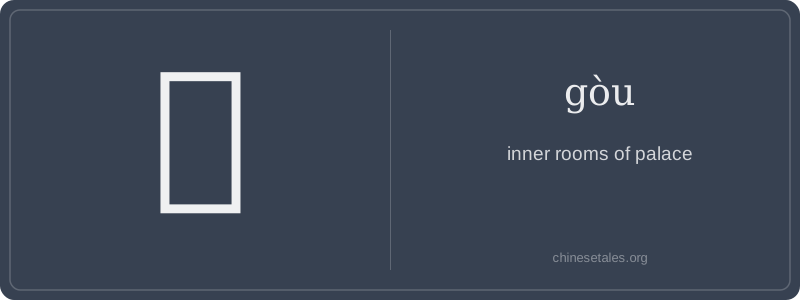
The earliest form of 冓 appears in Shang oracle bones as two parallel horizontal lines crossed by two verticals — like a simple floor plan of two adjoining rooms sharing a wall: ||. Over time, in Western Zhou bronze inscriptions, the shape became more stylized: the outer frame solidified into the radical 冂 (a downward-open enclosure), while the inner strokes evolved into two mirrored ‘X’-like forms (冖 + 冖), representing intersecting roof beams or partitioned spaces. By the Small Seal script, those inner elements fused into the modern top-heavy structure: 冂 framing two stacked, symmetrical ‘8’-shaped components — visually echoing interlocked architecture.
This pictorial logic held firm for millennia. In the *Zuo Zhuan*, 冓 appears in descriptions of palace layout: ‘the inner chambers where ancestral tablets were kept’ — always implying hierarchy, privacy, and structural integration. The character never meant ‘outer’ or ‘public’; its entire semantic gravity pulls inward. Even its sound gòu may echo the soft ‘kou’-like murmur heard behind thick palace screens — a whisper of containment, not confrontation.
Imagine stepping into the hushed, layered heart of an ancient Zhou dynasty palace — not the grand throne hall, but the quiet, private chambers behind the screens and corridors where royal women lived, plotted, or composed poetry. That’s the world 冓 evokes: ‘inner rooms,’ specifically the interlocking, enclosed inner spaces of elite architecture. It’s not just ‘room’ (房) or ‘hall’ (殿); it’s the architectural intimacy of nested, protected space — a meaning so specific it never made it into modern spoken Chinese or the HSK lists. You’ll almost never hear it in conversation today.
Grammatically, 冓 functions only as a bound morpheme — it never stands alone. Its real life is as a component in rare classical compounds like 冓合 (gòu hé), meaning ‘mutual joining’ or ‘interlocking union,’ often describing ritual marriage rites or structural harmony. Think of it like the Latin ‘inter-’ — invisible in daily speech but vital in precise, formal vocabulary. Learners sometimes misread its radical 冂 (jiōng, ‘downward open box’) as the more common 冖 (mì, ‘cover’), missing the spatial nuance: 冂 suggests enclosure *from above and sides*, like a canopy over inner chambers — not a lid, but a sheltering frame.
Culturally, 冓 carries quiet gendered resonance: in early texts, these ‘inner rooms’ were associated with the female domestic sphere — the qin (‘inner quarters’) where lineage, education, and etiquette were quietly preserved. Modern learners might mistakenly assume it’s related to ‘to meet’ (gòu 遘) because of the sound, but that’s a phonetic coincidence — no semantic link. Its rarity makes it a linguistic fossil: beautiful, precise, and utterly untranslatable without context.