冉
Character Story & Explanation
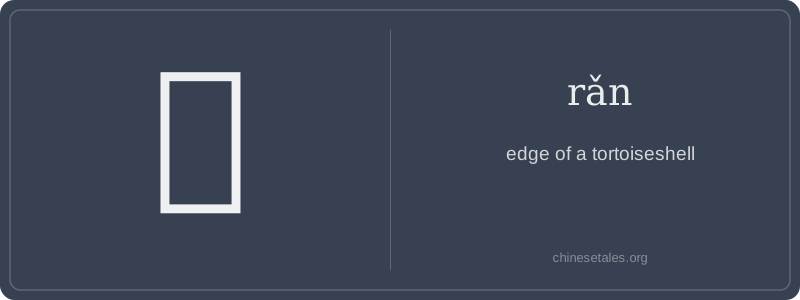
The earliest form of 冉 appears on Shang dynasty oracle bones as a stylized drawing of overlapping tortoiseshell plates — two gentle, parallel arcs curving upward and outward, with a small horizontal stroke connecting them at the base. Over centuries, the arcs simplified into the top two strokes (丿 and 丨), the connecting stroke became the central dot (丶), and the lower arc evolved into the two downward strokes (冂’s legs), eventually crystallizing into today’s five-stroke structure: 丿 丨 丶 乛 丨. Every stroke traces the shell’s organic swell — no sharp angles, only yielding curves.
This visual logic shaped its semantic journey: from literal ‘tortoiseshell edge’ → ‘curved, rising contour’ → ‘gradual, unhurried motion’. In the *Classic of Poetry* (Shījīng), 冉 appears in phrases describing banners fluttering softly in wind — not flapping sharply, but swaying with quiet persistence. Later, in Han dynasty texts, it acquired the adverbial sense ‘gently, slowly’, always retaining that tactile sense of smooth, layered emergence — like steam rising from tea, or dawn light spilling over hills.
At first glance, 冉 (rǎn) feels like a quiet ghost in modern Chinese — it’s not in the HSK, rarely appears in daily speech, and even many native speakers only encounter it in surnames or classical texts. But its core meaning is beautifully tactile: the curved, overlapping edge of a tortoiseshell — not just any edge, but the gently rising, layered rim where shell plates meet. This evokes softness, gradualness, and natural contour — a sense that still echoes in its poetic uses.
Grammatically, 冉 is almost never used alone today; it’s primarily a component in compound words or part of the surname Rǎn (e.g., Confucius’s disciple Ran Geng). When it does appear independently, it functions as an archaic adverb meaning 'gradually' or 'gently' — think of mist rising, hair fluttering, or time unfolding. You’ll see it in literary phrases like 冉冉升起 (rǎn rǎn shēng qǐ, 'rising slowly'), where the reduplication reinforces continuity and soft motion. Learners often misread it as 再 (zài, 'again') or 丹 (dān, 'cinnabar') — but those are structurally and semantically worlds apart.
Culturally, 冉 carries ancestral weight: the Ran family was one of the most prominent Confucian lineages, and the character appears in bronze inscriptions over 2,800 years old. Its rarity today makes it a linguistic time capsule — not obsolete, but reserved for elegance, reverence, or historical resonance. Don’t force it into casual speech; instead, appreciate how its five strokes hold millennia of quiet precision.