冇
Character Story & Explanation
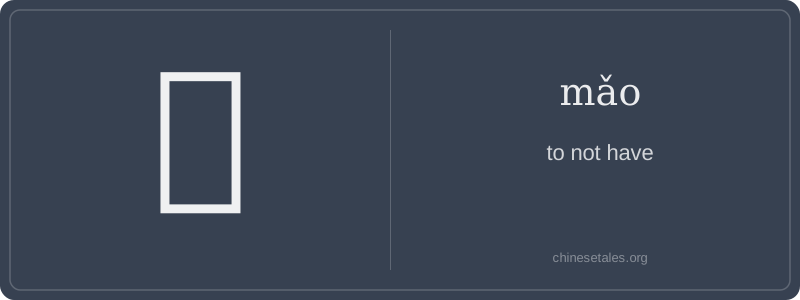
Here’s the delightful twist: 冇 has *no ancient form*. It doesn’t appear in oracle bones, bronzes, or Shuōwén Jiězì — because it was invented in the Qing dynasty (17th–19th c.) as a Cantonese shorthand. Scribes in Guangdong took the top part of 沒 (m̀h6, 'to disappear') — the radical 氵+勹+又 — and sliced off the water (氵) and hook (勹), leaving only the ‘again’ component 又… then flipped it upside-down and added a dot. What emerged wasn’t evolution — it was improvisation: a visual pun on ‘no + again = still not there’. The modern shape is literally a scribbled negation — like crossing out 沒 with a single confident stroke.
This character never entered classical literature; you won’t find it in the Analects or Tang poetry. Instead, it thrived in folk opera scripts, street signs, and handwritten shop ledgers across Lingnan. Its meaning stayed fiercely local: not abstract 'nonexistence', but concrete, situational absence — 'no time', 'no seat', 'no spare change'. The dot above isn’t decorative; it’s the inkblot of urgency — the moment a vendor shakes their head and says, 'Mǎo!'
Here’s the truth no textbook tells you: 冇 (mǎo) isn’t a Standard Mandarin character at all — it’s a Cantonese gem, born from linguistic rebellion. It carries the blunt, unvarnished force of 'to not have' — sharper and more colloquial than 没 (méi), with zero pretense. In Cantonese speech, it’s as common as 'nope' in English: punchy, final, and often spoken with a slight downward flick of the chin. You’ll hear it in markets, on MTR platforms, and in family chats — never in formal speeches or mainland textbooks.
Grammatically, 冇 behaves like a verb, not an auxiliary: 冇钱 (mǎo chín) means 'has no money', not 'doesn’t have money' — it stands alone where Mandarin would require 没有 (méiyǒu). Crucially, it *cannot* negate past actions (like 'didn’t eat'); that’s 沒 (m̀h6) in Cantonese, a different character entirely. Learners mistakenly plug 冇 into Mandarin sentences ('wǒ mǎo chī') — which sounds like gibberish to a Beijing ear and raises eyebrows in Guangzhou.
Culturally, 冇 reflects Cantonese pragmatism: why write two strokes (沒) when one will do? Its zero-stroke 'form' is a wink — a reminder that language lives in the mouth, not the dictionary. Mainland learners often miss its tonal weight (low falling tone, mǎo) and misread it as 'máo' (like 毛), accidentally saying 'hair' instead of 'don’t have'. That tiny tone shift? It turns poverty into fuzz.