円
Character Story & Explanation
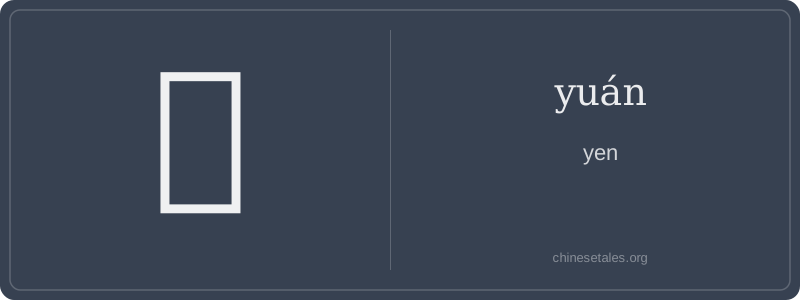
The character 円 originated not in ancient China, but in 17th-century Japan as a cursive simplification of the kanji 圓 (meaning 'round', 'circular'). Its oracle bone and bronze script ancestors are irrelevant here — because 円 has no pre-modern Chinese etymology. Visually, it evolved from 圓’s right-hand component: 圓 → ⻍ + 袁 → simplified to 冂 (a simple 'downward enclosure') plus a single horizontal stroke inside, representing the 'roundness' distilled into minimalism: four strokes total — a box (冂) with a flat lid (一). No curves, no flourishes — just clean, functional abstraction.
This minimalist redesign wasn’t philosophical — it was practical: faster writing for merchants trading with Dutch and Portuguese traders in Nagasaki. By the Meiji era, 円 became the official symbol for Japan’s new decimal currency, replacing the complex mon. When modern Chinese financial terminology absorbed Japanese loanwords (especially post-1895), 円 entered Mandarin not as a concept, but as a *label*: a visual shorthand for 'Japanese money'. Its meaning didn’t evolve organically in Chinese — it was imported, calibrated, and cordoned off strictly to cross-border finance. The shape doesn’t evoke 'value' or 'wealth'; it evokes 'Japan's version of a coin' — a geopolitical glyph.
Here’s the twist: 円 isn’t originally a Chinese character at all — it’s a Japanese kanji (the simplified form of 円, itself a variant of the traditional Chinese character 圓) that China adopted *only* as a foreign currency symbol for the Japanese yen. In Mandarin, it’s pronounced yuán and used exclusively in financial contexts when referring to Japanese money — never for Chinese yuan (which uses 元). This reflects how Chinese handles loanwords: not by transliterating sounds (like 'yen'), but by repurposing an existing character with visual and semantic resonance — 'round' → 'coin' → 'currency'. It feels clinical, precise, and slightly bureaucratic: you’ll only see it on bank forms, exchange rate boards, or finance textbooks.
Grammatically, 円 functions solely as a noun suffix, always following a numeral or amount, and is never pluralized or modified. You’d say '3000 円' (sān qiān yuán), never '3000 円钱' or '3000 円的'. Crucially, it’s *not* interchangeable with 元 — writing '3000 元' means 3000 Chinese yuan, not yen. Learners often mistakenly use 円 for RMB or assume it’s a general 'coin' character; it’s neither. Its usage is hyper-specific: Japan’s money, written in Chinese script, under Chinese grammatical rules.
Culturally, 円 is a quiet testament to Sino-Japanese lexical entanglement — a borrowed glyph wearing Chinese grammar like a tailored suit. It’s rarely taught outside finance or translation training, and many native speakers only recognize it from bank apps or travel documents. A common mistake? Confusing it with 元 (yuán) or 圆 (yuán), especially in handwriting — one stroke difference changes national currencies. Remember: 円 = Japan’s round coin, stamped with linguistic diplomacy.