冂
Character Story & Explanation
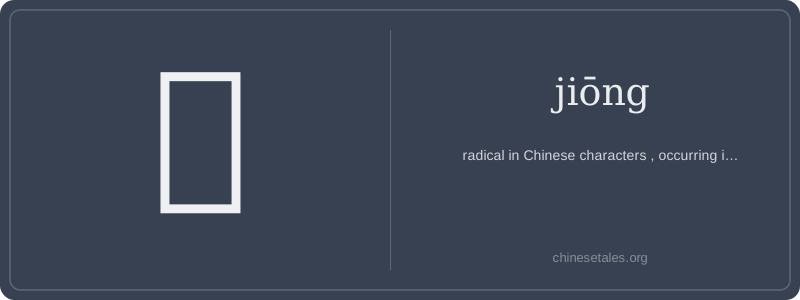
In oracle bone script (c. 1200 BCE), 冂 looked like a wide, low arch with two vertical pillars and a gentle curved lintel — unmistakably a city gate or outer rampart viewed head-on. Over centuries, the curve simplified: Shang bronze inscriptions straightened the top into a horizontal line, and by the small seal script of the Qin dynasty, it had crystallized into just two clean strokes — a left vertical, then a right vertical joined at the top by a short horizontal bar (though often omitted in modern writing). The bottom? Deliberately left open — no closing line, because a gate is *for passage*, not closure. Its minimalism isn’t laziness; it’s precision.
This openness shaped its semantic journey. In the Shuōwén Jiězì (100 CE), Xu Shen defined 冂 as ‘jiōng, outer city wall’ — emphasizing perimeter, not interior. Later, as characters like 同 (‘same’) evolved — combining 冂 + 一 + 口 — the frame came to symbolize shared context: ‘same’ only makes sense *within a bounded domain*. Even today, when you see 冂 in 網, it silently enacts that ancient logic: a net is defined not by its threads alone, but by the boundary they collectively form. It’s architecture made glyph — 3,200 years old and still framing meaning.
Forget 'character' — 冂 is a *frame*. Picture it: two strokes forming an open-top rectangle, like a doorway or a window frame. In ancient times, it literally depicted a city gate or outer wall — not the gate itself, but the *enclosing structure* that defined inside vs. outside. That’s why it’s called 同字框 (tóng zì kuàng), the 'same-character frame': it wraps characters like 同 (same), 用 (use), and 網 (net) — all concepts involving containment, boundary, or scope. It’s never used alone in modern speech; it’s purely a radical, a silent architect behind meaning.
Grammatically, 冂 doesn’t carry syntax — it doesn’t conjugate, modify, or function as a word. But its presence *shapes semantics*: in 用 (yòng), the 冂 frames the idea of ‘putting something into functional enclosure’ — using a tool within purposeful bounds; in 網 (wǎng), it encloses the threads (糸) to form a net’s boundary. Learners sometimes misread it as 口 (kǒu, mouth) or 凵 (kǎn, pit), but 冂 has no bottom stroke — it’s open, intentional, and always top-anchored.
Culturally, 冂 embodies an ancient Chinese spatial logic: identity arises from boundaries, not just content. Confucian texts emphasize ‘defining roles’ — like how 同 means ‘same’ only *within a shared frame*. Mistake it for 口, and you’ll miss the philosophical weight: this isn’t a mouth speaking, but a threshold deciding what belongs. And yes — though pronounced jiōng here, it’s the same shape hiding inside 网 (wǎng, net), where it visually *contains* the net’s structure. That duality — silent radical vs. embedded component — is its quiet superpower.