冀
Character Story & Explanation
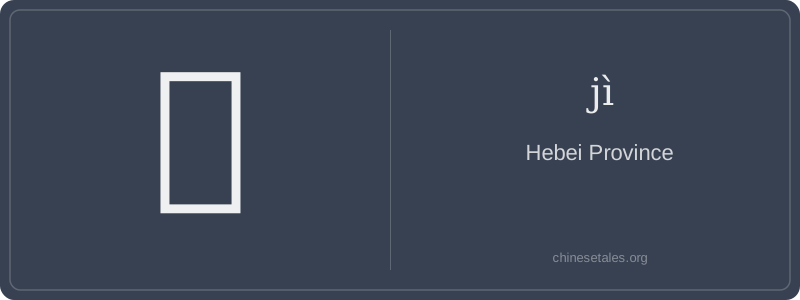
The earliest form of 冀 appears in bronze inscriptions of the Western Zhou (c. 1046–771 BCE) — not as a hopeful face, but as a complex scene: a kneeling figure (, later simplified to 北) beneath a roof-like canopy (亠), flanked by two hands (爫) reaching upward, all resting atop a base resembling a raised platform (田 or 土). Over centuries, the kneeling figure morphed into 北 (běi, 'north'), the hands fused into the top-left strokes, and the platform solidified into the lower 共 + 八 structure — ultimately crystallizing into today’s 16-stroke form with the radical 八 (bā, 'eight') anchoring its bottom, subtly echoing the idea of 'spreading out' or 'distribution' across territory.
This visual evolution mirrors its semantic journey: from depicting ritual supplication under heaven’s canopy (hence 'hope') to denoting the sacred northern territory entrusted to virtuous rule. The Shuō Wén Jiě Zì (121 CE) defines it as 'a state in the north, where the sages hoped for virtue' — linking geography, governance, and moral expectation. By the Han dynasty, 冀 had become synonymous with the Ji Prefecture (冀州), cementing its dual identity: a verb of longing and a noun of belonging — two meanings forever fused in one elegant, unyielding shape.
At first glance, 冀 (jì) feels like a quiet administrative footnote — just the ancient name for Hebei Province, used almost exclusively in formal contexts like maps, news headlines, or provincial license plates (e.g., 冀A for Shijiazhuang). But don’t mistake its rarity for simplicity: this character carries the weight of millennia. In classical Chinese, 冀 meant 'to hope for' or 'to expect' — a meaning still alive in literary or poetic registers (e.g., 冀望, jì wàng). Today, that sense is largely archaic in speech, yet it pulses beneath the surface: every time you see 冀 on a Hebei car, you’re literally looking at a fossilized verb — a province named not for geography, but for aspiration.
Grammatically, 冀 appears almost never as a standalone verb in modern Mandarin (unlike 希望, xī wàng). Instead, it’s a proper noun marker: always capitalized in translation ('Ji Province'), and always bound to place names or formal compounds. Learners sometimes mistakenly use it as a synonym for 'hope' — a classic error that sounds like quoting Confucius at a coffee shop. You wouldn’t say *我冀明天放假*; you’d say *我希望明天放假*. 冀 only ‘hopes’ when it’s wearing official robes.
Culturally, 冀 reveals how deeply Chinese naming embeds history into space: Hebei isn’t just ‘north of the Yellow River’ — it’s the land once ruled by the legendary Yu the Great’s son, who founded the ancient Ji state (冀州, Jì Zhōu), one of the Nine Provinces in the Yu Gong. That ancient ‘hope’ wasn’t abstract — it was the sovereign’s expectation of order, virtue, and harmony. Modern learners miss this layer when they treat 冀 as mere shorthand. It’s not a label — it’s a time capsule.