兣
Character Story & Explanation
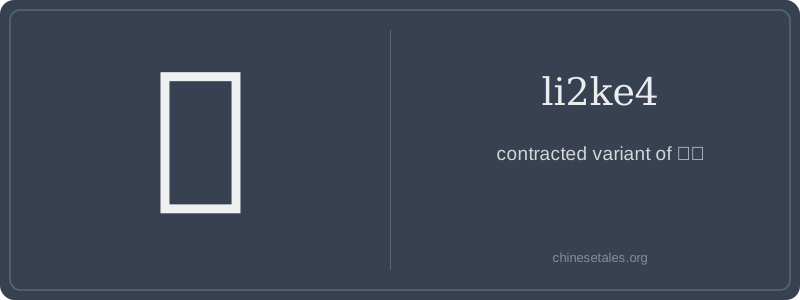
Here’s the twist: 兣 has no ancient origin at all — it doesn’t appear in oracle bones, bronze inscriptions, or even the Kangxi Dictionary. It emerged in the 1920s–30s during Shanghai’s printing boom, when compositors needed a compact glyph to represent the newly imported metric unit 'centigram'. Rather than typesetting two full characters (釐克), they fused them visually: taking the top dot and left stroke of 釐 (like the radical 亠 + 丿) and the right-hand 'mouth' shape of 克 (the 口), then collapsing the whole into a single, minimalist glyph — essentially a ligature, not a logograph. No strokes were added; strokes were *omitted*, leaving just the skeletal outline: a tiny dot overhead, a slanted stroke descending left, and a squat square base.
This visual reduction mirrors how spoken language contracts — think 'gonna' or 'wanna' — but in ink. Though never canonized in dictionaries, 兣 gained traction in pharmacopeias and food labeling across southern China and Taiwan, where handwritten precision mattered more than orthographic purity. Classical texts never mention it; Confucius wouldn’t recognize it. Yet its survival reveals something profound: Chinese script isn’t frozen in time — it breathes, adapts, and occasionally scribbles shortcuts in the margins of modernity. Its 'shape' isn’t drawn — it’s *erased* down to functional essence.
Think of 兣 like the Chinese equivalent of the 'oz' abbreviation on a U.S. cereal box — not an official SI unit symbol, but a compact, colloquial shorthand that slipped into everyday use through convenience and habit. It’s a contraction of 釐克 (líkè), meaning 'centigram' (0.01 gram), and carries none of the weight or authority of standard units like 克 (g) or 千克 (kg). Unlike formal scientific writing — which uses only 克, 毫克, or micrograms — 兣 appears almost exclusively in informal contexts: handwritten notes, local market price tags, herbal medicine prescriptions, or old-style apothecary labels where space is tight and tradition runs deep.
Grammatically, 兣 functions strictly as a noun suffix attached to numerals — never standalone, never modified by adjectives, and never used in verbs or compounds like 克 does (e.g., 克服 'to overcome'). You’ll see it only in phrases like '5 兣' or '0.3 兣', always with a number or decimal. Crucially, it’s *never* pronounced líkè in isolation — only as li2ke4 when reading the contracted form; the full term 厘克 is still pronounced líkè, but that’s a separate lexical item with different orthographic expectations.
Culturally, 兣 is a quiet relic of China’s early 20th-century metrication drive — a time when translators improvised characters to bridge Western science and Chinese script. Learners often mistakenly treat it as a 'real' character with strokes or radicals, or worse, confuse it with 克 (kè) and assume it means 'gram'. But 兣 has *zero strokes* — it’s a pure typographic artifact, born from typesetting economy, not etymology. Its absence from HSK isn’t oversight; it’s a signal: this isn’t for exams — it’s for spotting the subtle fingerprints of linguistic pragmatism in real-world Chinese.