兟
Character Story & Explanation
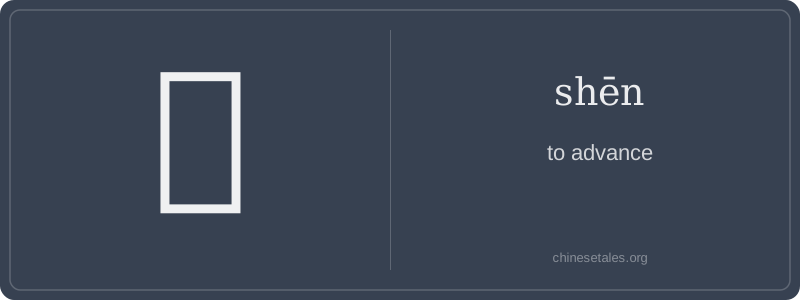
The earliest form of 兟 appears in bronze inscriptions from the late Zhou dynasty (c. 5th century BCE) as two stacked ‘person’ radicals (人), one atop the other, both facing right — a stylized image of two figures ascending a staircase or ramp. Over centuries, the upper 人 simplified into the top strokes (丿一), while the lower 人 evolved into the radical 儿 (a crouching or stepping figure), and the middle horizontal stroke (一) emerged as a unifying beam — visually representing *support* for upward motion. By the Han dynasty, the structure solidified into today’s 12-stroke form: two diagonal strokes (丿丿), three horizontals (一一一), and the 儿 radical anchoring the base.
This visual logic directly shaped its meaning: advancement through cooperation, guidance, or hierarchical support — think of a senior mentor lifting a junior up a ladder, or a dynasty progressing under wise rule. In the Book of Rites (Lǐjì), 兟 appears in the phrase ‘兟兟不息’ (shēn shēn bù xī), describing the unceasing, orderly rise of virtue — not explosive growth, but persistent, interdependent ascent. Even today, its shape whispers that true progress isn’t solitary sprinting; it’s two people, step by step, sharing weight and direction.
At first glance, 兟 feels like a quiet, almost forgotten cousin of more common 'advance' characters like 进 (jìn) or 前 (qián). But its meaning — 'to advance', especially with purposeful, upward momentum — carries an elegant precision. It’s not just movement forward; it’s *progressive ascent*, like climbing stairs with deliberate intent. You’ll rarely hear it in casual speech — it lives in classical allusions, formal writing, and poetic compounds where nuance matters. Think of it as the 'architectural verb' for advancement: measured, structural, dignified.
Grammatically, 兟 is almost never used alone. It appears exclusively in disyllabic words (like 兟进 or 兟升), always paired with another character to form a verb or noun. It doesn’t take aspect particles (了, 过, 着) on its own — you’d say ‘兟进了’ only if embedded in a compound like ‘稳步兟进’, never *‘兟了’. Learners often mistakenly try to use it as a standalone verb (e.g., *‘我兟了一步’), which sounds jarringly archaic or nonsensical — like quoting Confucius mid-sentence at a coffee shop.
Culturally, 兟 reflects the Chinese value of *orderly progress*: not chaotic hustle, but stepwise, grounded, morally aligned advancement. Its rarity today isn’t neglect — it’s preservation. Like a ceremonial sword kept in its scabbard, 兟 appears when the context demands gravitas: policy documents, scholarly prefaces, or inscriptions on university gates. Mispronouncing it as shēn (not shēnɡ or xīn) is common — but remember: the ‘shēn’ sound echoes the steady, breath-controlled pace of climbing stairs — one step, then another, then another.