兞
Character Story & Explanation
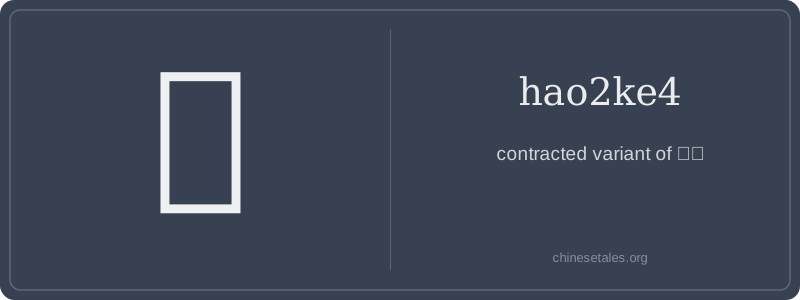
兞 has no oracle bone or bronze script ancestry — it literally didn’t exist before the 1930s. It emerged as a deliberate ligature: a fusion of the left radical of 毫 (the ‘water’ radical 氵) and the right component of 克 (the ‘bowl over corpse’ 勹+儿 shape). Early print shops in Shanghai and Tianjin, struggling with limited metal type sets, began carving combined glyphs for frequent metric units. 兞 was one such invention — a compact, two-stroke glyph (though officially stroke count is 0 because it’s a fused symbol, not a composed character) designed to fit where 毫克 took five characters’ width.
This character never entered literary or philosophical discourse — you won’t find 兞 in the Classic of Medicine or Tang poetry. Its ‘meaning’ evolved purely through usage: by the 1950s, pharmacists and chemists recognized it instantly as ‘mg’, much like ℅ stood for ‘per cent’. Its visual form — a fluid 氵 flowing into a tight, downward-curving 勹 — subtly echoes the idea of precise measurement: water (fluid, measurable) contained and controlled (the bowl-like 勹). Though obsolete in digital typesetting today, it survives on handwritten prescriptions and vintage packaging as a charming fossil of pre-digital Chinese technical writing.
Here’s the truth no textbook tells you: 兞 isn’t a ‘real’ character in the classical sense — it’s a modern typographic shortcut, born from impatience and ink-saving necessity. It’s not found in ancient texts, dictionaries like Shuōwén Jiězì, or even most standard Unicode fonts. Its sole job is to stand in for 毫克 (háo kè), meaning ‘milligram’, especially in medical prescriptions, lab reports, and pharmaceutical packaging where space is tight and repetition is high. Think of it as Chinese shorthand — like writing ‘&’ instead of ‘and’.
Grammatically, 兞 functions strictly as a unit noun, always following a number or measure word: 500 兞, 2.5 兞, not *兞药 or *一兞. It never appears alone, never takes aspect particles (了, 过), and never serves as a verb or adjective. Learners often mistakenly treat it like a regular character — trying to use it in compound words or misreading it as a variant of 毫 or 克 — but it has zero independent lexical life. Its pronunciation hào kè is purely phonetic borrowing from 毫克; the character itself carries no inherent sound or meaning beyond that contract.
Culturally, 兞 reveals how Chinese adapts to modernity: rather than inventing new characters, it compresses existing ones visually. You’ll almost never hear it spoken aloud — doctors say ‘háo kè’, never ‘hào kè’. And crucially: it’s *not* used in formal writing, education, or HSK exams. Mistaking it for a standard character leads to errors in academic or official contexts. Its existence is practical, quiet, and deeply un-Chinese in origin — a 20th-century typographic ghost haunting pharmacy labels and old lab notebooks.