兝
Character Story & Explanation
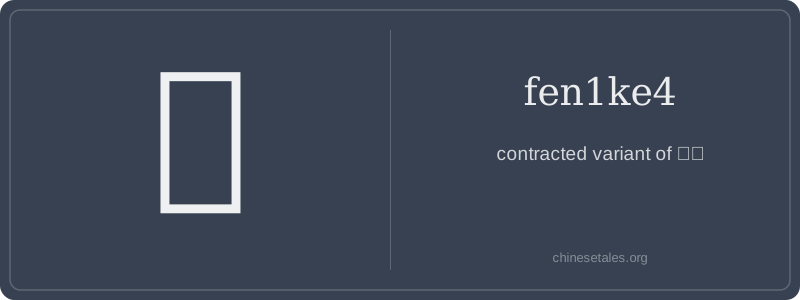
Here’s the twist: 兝 has *no ancient origin*. Unlike nearly every other Chinese character, it does *not* appear in oracle bone inscriptions, bronze script, or seal script — because it didn’t exist until the 20th century. It emerged not from pictographic evolution, but from handwriting economy: scribes and technicians began merging the left radical of 分 (fēn, 'tenth') — the 'knife' radical 刂 — with the top of 克 (kè) into a single fluid stroke, collapsing 分克 into a compact ligature. Visually, it looks like 刂 + 一 + 丨 + 丿 — a hurried fusion, not a designed glyph.
This character is a product of modern metric standardization in Republican-era China (1910s–1930s), when Western units were being localized. It never entered classical texts — no Confucian canon, no Tang poetry, no Ming novels mention it. Its 'meaning' isn’t derived from etymology but from context and convention: it’s literally a visual abbreviation, like 'lb' for 'pound' or 'oz' for 'ounce'. Even its Unicode encoding reflects this liminal status: it lives in the 'Compatibility' zone — a digital attic for legacy glyphs that aren’t full-fledged characters. Its story isn’t one of cultural continuity, but of pragmatic adaptation under time pressure.
Think of 兝 as Chinese scientific shorthand’s equivalent of the ampersand (&) — not a true character in its own right, but a practical, handwritten contraction that slipped into print like a typographical inside joke. It stands for 分克 (fēn kè), meaning 'centigram' (0.01 gram), and carries none of the semantic weight or historical depth of standard characters — it’s purely functional, born from lab notebooks and pharmacy labels where speed trumps tradition.
Grammatically, 兝 behaves like a unit noun: it always follows a number or measure word and never appears alone or modifies nouns directly. You’ll see it in phrases like '5 兝' (wǔ fēnkè), never '兝的药' (*'the 兝 medicine'). Crucially, it’s *not* used in formal writing, exams, or digital input — most keyboards don’t even support it. Typing 'fenke' yields 分克, never 兝. Learners often mistakenly treat it as a standalone lexical item or try to use it in speech (it’s *never* pronounced 'fēnkè' — only read aloud as 'fēn kè' two separate syllables).
Culturally, 兝 is a quiet rebel: it’s officially unlisted in the GB2312 and Unicode’s CJK Unified Ideographs (though it appears in Unicode’s 'CJK Compatibility' block as U+515D), and it’s absent from all HSK lists, dictionaries, and language curricula — yet pharmacists in Shanghai and chemists in Chengdu still scribble it daily. The biggest mistake? Assuming it’s 'standard' because you’ve seen it on a pill bottle. It’s not — it’s linguistic duct tape: useful, unofficial, and quietly disappearing in favor of digital precision.