兛
Character Story & Explanation
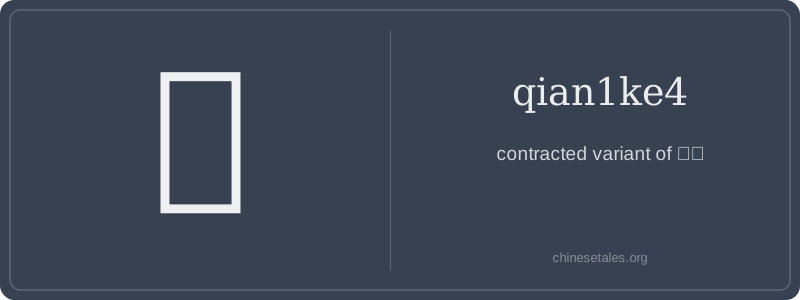
Here’s the twist: 兛 has *no oracle bone or bronze inscription origin* — because it doesn’t exist in pre-modern Chinese at all. It emerged in the early 20th century as a deliberate typographic fusion of 千 (left half: 十 + 人-like component) and 克 (right half: 丨 + 儿 + 丷). Printers and typesetters combined the left radical of 千 (the ‘ten-thousand’ part, simplified here to 十 + 人 shape) with the right side of 克 (the ‘overcome’ character, whose lower portion resembles 児), creating a compact, monospace glyph that visually echoes both source characters — yet belongs to no historical script lineage.
This character is a linguistic fossil of industrialization: first documented in 1930s Chinese metric system adoption documents and standardized in GB/T 15835–2011 as an approved variant for ‘kilogram’. Unlike classical characters shaped by calligraphy and meaning, 兛 was engineered for ink efficiency and grid alignment on mechanical type trays. Its ‘evolution’ wasn’t organic — it was designed in a drafting room, not carved on turtle shells. That’s why it feels so stark and geometric: it’s not a painting of reality, but a symbol optimized for precision — a true child of the metric age, wearing its utilitarian soul on its sleeve.
Let’s cut to the chase: 兛 isn’t a ‘real’ character in the traditional sense — it’s a clever, space-saving *typographic contraction*, born not from ancient philosophy or poetic imagery, but from the practical need of engineers, pharmacists, and label designers to fit ‘kilogram’ into tight spaces. Pronounced ‘qiān kè’, it’s literally just 千克 (qiān kè) fused into one glyph — like writing ‘lb’ for ‘pound’ in English. It carries zero semantic weight on its own; it’s pure shorthand, and Chinese speakers instantly recognize it as such — no ambiguity, no history, no hidden layers… just efficiency.
Grammatically, 兛 behaves exactly like 千克: it’s a measure word that follows numerals (e.g., 5 兛), never stands alone, and never takes classifiers or aspect particles. You’ll never say ‘兛了’ or ‘一兛个苹果’ — that’s a hard grammar red flag. It appears almost exclusively in technical contexts: food packaging (‘净含量:2.5兛’), lab reports, shipping manifests, or old-style metrology charts. Outside those domains, native speakers default to 千克 — it’s more legible, more formal, and safer.
Culturally, 兛 is a quiet testament to how Chinese adapts to modernity without breaking its script’s logic. Learners often mistakenly treat it as a ‘character to memorize’ — puzzling over nonexistent radicals or stroke order — when in truth, it has *zero strokes* (it’s a ligature, not a glyph with brushwork). The biggest trap? Assuming it’s used conversationally. It isn’t. You’ll never hear someone say ‘wǒ mǎi le sān 兛 mǐ’ — they’ll say ‘sān qiān kè’. Think of 兛 as Chinese’s version of ‘&’ or ‘@’: functional, familiar in print, but utterly silent in speech.