兙
Character Story & Explanation
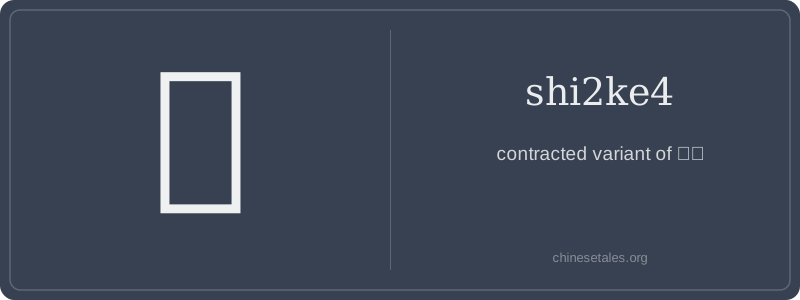
The ‘origin’ of 兙 isn’t ancient — it’s 20th-century practicality. There is no oracle bone or bronze script version, no seal script evolution. It emerged in mid-1900s Chinese scientific publishing as a space-saving ligature: typesetters fused 十 and 克 into a single compact glyph to fit tight margins on medicine vials, chemical reagent labels, and wartime ration charts. Visually, it stacks 十 (a simple cross) atop 克 (which itself evolved from a pictograph of a ‘helmeted warrior’ → ‘to overcome’ → ‘unit of weight’), but compressed so tightly they merge — the top bar of 克 disappears, and the 十 nestles into the remaining vertical stroke and hook. No calligrapher ever practiced this ‘character’; it was engineered, not inherited.
Its meaning didn’t evolve — it was assigned. Unlike characters whose semantics deepened over millennia (e.g., 道 shifting from ‘road’ to ‘the Way’), 兙 has held one rigid, hyper-specific meaning since inception: *exclusively* ‘ten grams’ in metric measurement contexts. You won’t find it in the Shuōwén Jiězì, Tang poetry, or Ming novels — it’s a child of standardization, not literature. Its visual austerity mirrors its function: no flourish, no ambiguity, just precision in miniature — a tiny monument to modernity’s demand for efficiency over elegance.
Here’s the truth no textbook will tell you: 兙 isn’t a ‘real’ character in the classical sense — it’s a modern typographic shortcut, born not from oracle bones but from lab notebooks and pharmaceutical labels. Pronounced shí kè, it’s a contraction of 十克 (‘ten grams’), designed purely for efficiency in scientific, medical, and packaging contexts. Visually, it looks like a cramped fusion of 十 (shí, ‘ten’) and 克 (kè, ‘gram’), but it has zero strokes of its own — officially stroke count is 0, because it’s not composed of strokes at all; it’s a single, indivisible glyph unit encoded in Unicode (U+5159) as a compatibility character. It’s not drawn; it’s inserted.
Grammatically, 兙 functions strictly as a noun modifier — never standalone, never verbalized, never pluralized. You’ll see it only after a numeral or measure word: 5兙 (wǔ shí kè), 0.3兙 (líng diǎn sān shí kè). Crucially, it *never* appears without a number preceding it — saying just ‘兙’ is as unnatural as saying ‘lbs’ alone in English. Learners often mistakenly treat it like a regular character: trying to write it stroke-by-stroke, using it in essays, or even looking it up in traditional dictionaries (where it won’t appear).
Culturally, 兙 is a quiet rebel — a bureaucratic artifact that slipped into Unicode despite having no historical pedigree. It’s beloved by pharmacists, nutritionists, and food label designers across China and Taiwan, yet absent from HSK, textbooks, and even most input methods (you usually type ‘shike’ and select it from a special symbol panel). Its quirk? It’s one of the few Chinese ‘characters’ that’s fundamentally *digital-native*: conceived for screens and print, not brush and ink.