兕
Character Story & Explanation
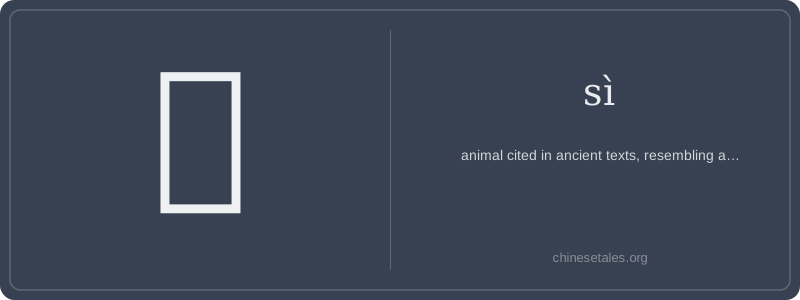
The earliest form of 兕 appears on Shang dynasty oracle bones as a vivid, sideways profile of a massive horned beast — thick neck, sweeping curved horn, heavy jaw, and two stout legs. The top stroke was the horn; the middle crossbar became the eyes and snout; the lower part evolved from bent legs into the modern 儿 (ér) radical — not ‘child’, but a stylized depiction of hindquarters and hooves. Over centuries, the horn simplified into the top dot and horizontal stroke (丶一), the face condensed into the vertical stroke and hook (亅), and the legs fused into the crouching 儿 shape — turning a dynamic animal sketch into a compact, solemn glyph of seven strokes.
This evolution mirrors its semantic journey: from a possibly real, now-extinct bovine (some scholars link it to the extinct *Elasmotherium*, the ‘Siberian unicorn’) to a mythic symbol of primal force and imperial authority. In the Zuo Zhuan, Duke Xiang of Jin ‘dreams of a sì charging from the south’ — interpreted as an omen of upheaval. Its appearance in the Tao Te Ching ties it to natural law: when virtue wanes, even the sì sheds its horn — a metaphor for irreversible decline. Visually, the character’s downward weight (that squat 儿 base) embodies this sense of grounded, unstoppable presence.
Forget 'buffalo' — 兕 (sì) is a ghost of ancient China, not a real animal you’ll spot in a zoo or textbook. It’s a literary fossil: mentioned in the Classic of Poetry, the Book of Documents, and famously in the Tao Te Ching (‘When the Great Way declines, benevolence and righteousness appear — like the rhinoceros shedding its horn, or the sì losing its hide’). To native speakers, 兕 doesn’t evoke biology — it evokes antiquity, solemnity, and poetic weight. You won’t hear it in daily speech; it appears only in classical allusions, scholarly essays, or ornate inscriptions — like using ‘thou’ or ‘verily’ in modern English.
Grammatically, 兕 is a noun — always singular, never pluralized or modified by measure words like 一隻 (yī zhī); instead, it takes archaic counters like 一頭 (yī tóu, ‘one head’) or stands bare in parallel couplets. Learners sometimes mistakenly treat it like a regular noun and say *一隻兕*, which sounds jarringly anachronistic — like putting sneakers on a Ming dynasty scholar. It never appears in verb phrases or compounds with modern function words; its syntax is frozen in bronze-age grammar.
Culturally, 兕 represents how Chinese values linguistic economy and historical resonance: one character carries millennia of layered meaning — mythical power, moral decay, and cosmic harmony — without needing explanation. Mistake it for a common animal name, and you miss the ritual gravity it holds. Its rarity isn’t accidental — it’s preserved like a ceremonial jade bi, not used, but revered.