儽
Character Story & Explanation
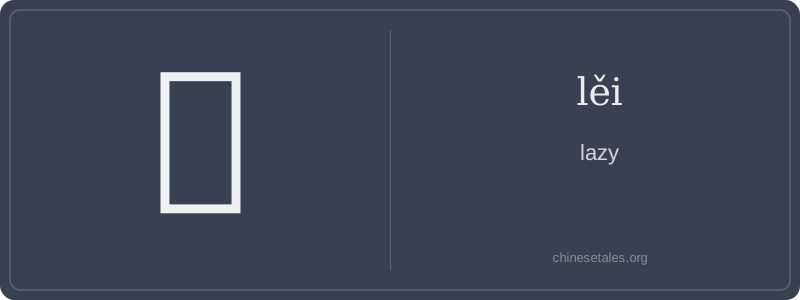
The earliest form of 儽 appears in bronze inscriptions as a complex pictograph: a kneeling person (亻) beside a heavy, piled-up structure resembling stacked stones or bundles — possibly representing burdens, luggage, or ritual offerings. Over centuries, the right side simplified from a multi-layered glyph into the current form: three '田' (field)-like units stacked vertically, evoking accumulation and weight. The left 'person' radical remained consistent, anchoring the meaning in human experience. By the Han dynasty, seal script standardized it into the shape we recognize — still unmistakably depicting a person bowed under layered load, not lounging idly.
This visual logic shaped its semantic evolution: 儽 never meant 'unwilling to work'; it meant 'bent low by accumulated fatigue'. In the Zuo Zhuan, it describes envoys returning '儽然' after exhausting diplomatic missions. In Du Fu’s poetry, 儽儽 appears to depict war refugees staggering under grief and hunger — their exhaustion is visceral, moral, and societal. The character’s very strokes echo the slumped spine and downward pressure of relentless responsibility — a stark contrast to the carefree connotations of Western 'laziness'.
Think of 儽 (lěi) not as the English 'lazy' — which carries moral judgment and inertia — but as the ancient Chinese concept of 'bone-deep weariness': the slump of a scholar after ten hours of calligraphy, the sigh of a farmer at dusk, the weight of accumulated duty. It’s less about avoiding work and more about being *overburdened to the point of physical collapse* — like the English idiom 'dragging one’s feet' but with the gravity of a stone tablet. In classical usage, it often described exhaustion from ritual obligation or prolonged travel, not sloth.
Grammatically, 儽 is almost never used alone in modern Mandarin — it appears almost exclusively in fixed literary compounds (like 儽儽) or as part of poetic reduplication meaning 'weary, haggard, spent'. You won’t say '他很儽' (He is lazy) — that would sound archaic and bizarre. Instead, it modifies nouns or verbs descriptively: 儽儽然 (lěi lěi rán) — 'in a weary, drooping manner', or 儽然 (lěi rán) — 'looking utterly spent'. It behaves like an adverbial or adjectival modifier, not a standalone adjective.
Culturally, mistaking 儽 for common 'lazy' words like 懒 (lǎn) is the #1 learner trap — they’re worlds apart in register, origin, and connotation. Using 儽 in casual speech will make you sound like a Tang dynasty poet quoting Du Fu. Also, its radical isn’t 'person' — it’s actually the 'human' radical (亻) on the left, but learners often misread the right side as '累' (lěi, 'tired') when it’s a distinct, archaic component. This character doesn’t belong in HSK because it lives in poetry, not groceries.