俨
Character Story & Explanation
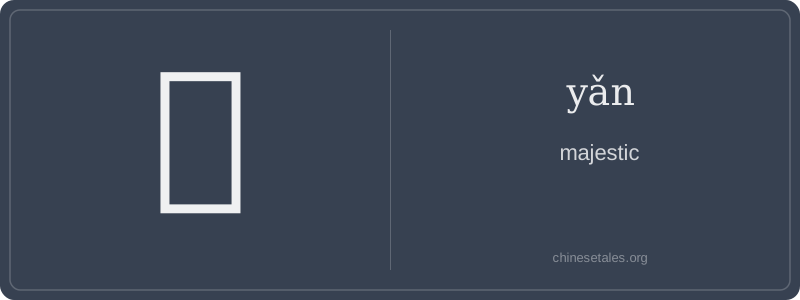
The earliest form of 俨 appears in seal script as a combination of 亻 (person) and 嚴 (yán, strict, solemn), which itself evolved from a bronze inscription showing a person standing upright beside a ceremonial drum and a bound prisoner — symbolizing judicial gravity and unyielding order. Over centuries, the complex 嚴 simplified to 严 (modern simplified form), and when paired with the 亻 radical, the character 俨 emerged as a distinct variant emphasizing *human embodiment* of that solemnity — not just rules, but the person who *is* the rule made visible.
By the Tang and Song dynasties, 俨 became a literary staple for describing figures who incarnated virtue: Du Fu wrote of Confucius 俨若神明 (yǎn ruò shénmíng, 'majestic as a deity'), and Sima Guang described loyal ministers whose bearing was 俨然不可犯 (yǎnrán bùkě fàn, 'so solemn they could not be violated'). Its visual structure — a person (亻) literally supporting the weight of 'strictness' (严) — mirrors its semantic core: majesty as disciplined humanity, not divine force.
Imagine walking into an ancient Confucian academy at dawn: incense curls upward, scholars stand perfectly still in silk robes, and the headmaster stands at the lecture platform — not shouting, but radiating such quiet authority that even a rustling leaf seems disrespectful. That’s 俨 (yǎn): not loud power, but *majestic composure* — a dignified, solemn gravitas that commands reverence without effort. It’s not about size or noise; it’s about presence so complete it bends the air around it.
Grammatically, 俨 is almost always used in fixed literary phrases — never alone, rarely as a verb. You’ll see it in classical-style adverbial constructions like 俨然 (yǎnrán), meaning 'as if' or 'just like', often evoking resemblance with solemn weight: 俨然一位将军 (yǎnrán yī wèi jiāngjūn) — 'as if he were a general'. Learners mistakenly try to use it like 气势汹汹 (qìshì xiōngxiōng, 'fierce and threatening') or 威严 (wēiyán, 'imposing authority'), but 俨 carries no aggression — only serene, unshakeable dignity.
Culturally, 俨 appears mostly in formal writing, historical fiction, or poetic description — think biographies of sages or descriptions of ancestral halls. It’s nearly absent in spoken Mandarin and completely missing from daily conversation. A common mistake? Using it where 看起来 (kàn qǐlái, 'it seems') would suffice — instantly sounding archaic or mock-solemn. Remember: 俨 isn’t ‘majestic’ as in a Hollywood throne room — it’s the hush before the bell rings in a temple.