傥
Character Story & Explanation
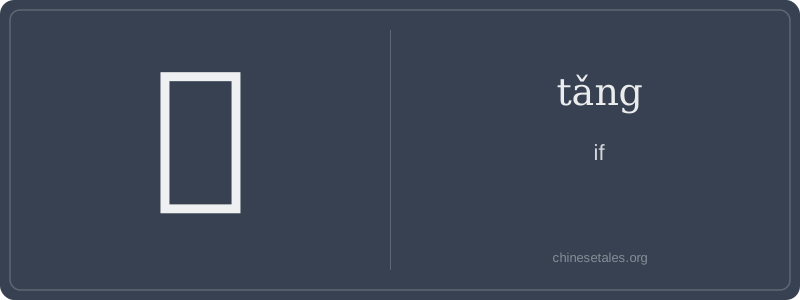
追溯字形,傥最初见于小篆(c. 3rd c. BCE),由‘人’(亻)与‘党’(dǎng)组成 — 但‘党’在此并非现代‘party’义,而是声旁兼表意:古‘党’字从‘尚’从‘黑’,本义为‘族中同色者’,引申为‘同类、相合’。小篆中‘傥’左为‘人’部,右为‘党’的简写变体,整体构形暗示‘人之相合而生变数’ — 即人在相似情境下,行为或结果却未必相同, 因而需以‘倘若’来悬置判断。楷书定型后,12画结构稳定:亻(2画)+ 尚(8画)+ 丶(1画)+ 一(1画)— 注意右下那一点一横,正是‘党’字末笔的优雅收束。
意义演变上,傥在《庄子》《史记》中已作假设连词使用,如《史记·刺客列传》‘傥有不测’(tǎng yǒu bù cè, ‘should something unforeseen occur’)。有趣的是,其本义曾指‘卓然不群’(see 倜傥 tì tǎng — ‘unconventional, dashing’),后因音近义转,借为条件连词。视觉上,‘亻’提示与人相关的主观判断,‘党’暗示情境的类比性 — 真正的 ‘if’ here is not logical necessity, but human-scale contingency.
At first glance, 傥 (tǎng) looks like a formal, almost literary cousin of the everyday 'if' — but it’s far more nuanced. It doesn’t just mean 'if'; it conveys conditional possibility with a quiet air of elegance, detachment, or even philosophical openness — think 'were it the case that...', 'should it happen that...', or 'supposing...'. You’ll rarely hear it in casual speech; instead, it lives in classical allusions, essay writing, and rhetorical flourishes where tone matters as much as logic.
Grammatically, 傥 is a pre-verbal adverb — always placed before the verb, never at the sentence start like English 'if'. It pairs naturally with 可 (kě, 'may'), 能 (néng, 'can'), or even 未 (wèi, 'not yet') to soften assertions: 傥可一试 (tǎng kě yī shì, 'might as well give it a try'). Unlike modern conditionals like 如果 (rúguǒ), 傥 implies no strong expectation — just poised readiness for a hypothetical world. Learners often misplace it (e.g., saying *傥你来… instead of 傥你来… — which is actually acceptable but archaic) or overuse it thinking it’s a 'fancier if', when native speakers reserve it precisely for moments requiring tonal restraint.
Culturally, 傥 reflects the Chinese literary tradition’s love of implication over insistence. Its presence signals humility before uncertainty — not 'I’ll do X if Y happens', but 'should Y happen, perhaps X may follow'. That subtle deference to fate, contingency, and understatement is deeply Confucian and Daoist at once. Mistake it for a simple synonym of 如果, and you risk sounding either comically stiff or unintentionally poetic — like quoting Tang poetry at a coffee shop.