傩
Character Story & Explanation
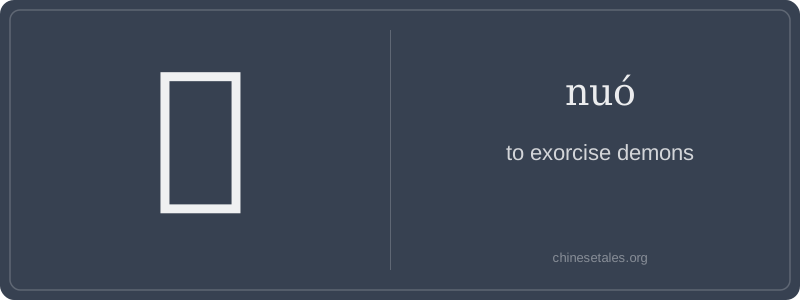
The earliest form of 傩 appears in Warring States bamboo slips as 亻+難 — not a pictograph, but a phono-semantic compound. The left side 亻 (rén bàng, 'person radical') signals human agency; the right side 難 (nán, 'difficult, perilous') originally carried both sound and meaning: exorcism was inherently dangerous work — confronting spirits that could retaliate. Over centuries, 難 simplified visually, losing its bird-like oracle bone shape and contracting into the modern 难 component, while the 亻 remained firmly anchored on the left — a quiet reminder that this rite required trained human performers, not passive priests.
By the Han Dynasty, 傩 had crystallized into a state-sanctioned winter purification rite called 大傩 (dà nuó), described in the Book of Rites: 'One hundred masked men beat drums and shout “Nuo!” to expel plague-spirits from the palace.’ The shout itself — “Nuó!” — became the name of the ritual. Crucially, the character’s visual weight (12 strokes) mirrors its cultural gravity: each stroke echoes the precision of mask carving, drumbeat timing, and chant cadence. Even today, when a Nuo master carves a new mask, he traces the character 傩 in red ink first — not as writing, but as invocation.
Think of 傩 (nuó) as China’s ancient answer to a Hollywood exorcist — but instead of whispered Latin and holy water, it’s masked dancers stomping in synchronized rhythm, shaking bronze bells to shatter evil like glass. At its core, 傩 isn’t just ‘to exorcise’; it’s a ritual *act* — visceral, communal, and charged with sacred theatre. Unlike generic verbs like 驱 (qū, 'to drive away'), 傩 implies ceremonial performance: the mask, the drum, the prescribed steps. You’ll almost never see it alone — it lives in compounds like 傩戏 or 傩舞.
Grammatically, 傩 is almost exclusively nominal or adjectival in modern usage — you won’t say 'I nuó the ghost' (✘). Instead, it modifies nouns: 傩仪 (nuó yí, 'Nuo ritual'), or appears as the head of compound words. When used verbally in classical texts, it’s highly literary and archaic — like saying 'beseech' instead of 'ask' in English. Learners often misread it as a verb they can conjugate; it’s not — treat it like 'shamanism' or 'liturgy': a concept, not an action word you toss into daily speech.
Culturally, 傩 bridges folk belief and state ritual: Zhou Dynasty court officials performed 傩仪 to purify the capital before spring; today, rural villages in Jiangxi and Guizhou still stage 傩戏 with 800-year-old wooden masks. A common mistake? Assuming it’s interchangeable with 驱邪 (qū xié, 'ward off evil') — but 驱邪 is a general phrase; 傩 is a specific, embodied tradition. It’s not *what* you do — it’s *how*, *who*, and *with what music* you do it.