儹
Character Story & Explanation
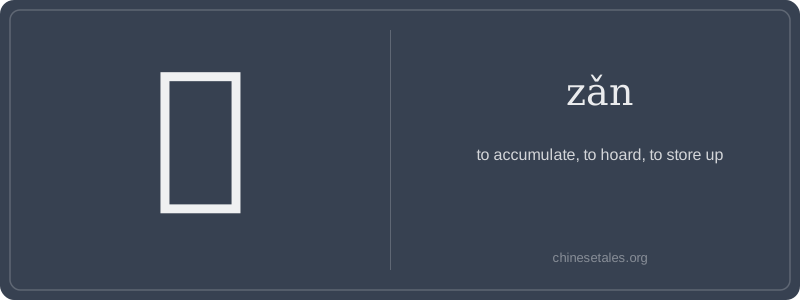
The earliest form of 儹 appears in late Warring States bamboo slips as a complex compound: left side 人 (rén, ‘person’) or its variant 亻 (radical), right side a stacked, multi-layered glyph resembling piled grain or bundled cloth—possibly derived from 戔 (jiān, ‘small, repeated units’), suggesting incremental addition. Over centuries, the right side condensed and stylized: the top ‘two horizontal strokes + cross’ evolved into the modern 曽 (zēng, archaic variant of 曾), while the lower part solidified into 日 (rì, ‘sun/day’), symbolizing time-bound accumulation—each day adding another layer. The radical 亻 anchors it in human agency: this isn’t accidental piling—it’s *people* doing the accumulating.
By the Han dynasty, 儹 appeared in texts like the *Shuōwén Jiězì* (c. 100 CE) defined as ‘jī xù’ (to gather and store), used for hoarding grain against famine or amassing virtue over lifetimes. In Tang poetry, it described scholars 儹學 (zǎn xué)—‘accumulating learning’ through decades of study. Its visual density—19 strokes, tightly packed—mirrors its semantic heft: every stroke feels like another bundle tied, another coin tucked away. Even today, calligraphers note how its compressed right side creates visual tension—like pressure building before release.
Imagine Auntie Lin in her tiny Shanghai apartment, carefully folding every red envelope (hóngbāo) she receives during Spring Festival—not to spend, but to tuck into a lacquered chest beneath her bed. She doesn’t just ‘save’ money; she 儹 it—layer by layer, year after year, with quiet intention and almost ritual patience. That’s the soul of 儹: not passive storage, but active, deliberate accumulation—of wealth, time, energy, or even resentment. It carries weight, foresight, and sometimes a faint whiff of secrecy or caution.
Grammatically, 儹 is almost always transitive and verb-only—it needs an object (e.g., 儹錢, 儹經驗). You won’t say *‘wǒ zǎn’* alone; it’s *‘wǒ zǎn le yì bǐ qián’* (I’ve accumulated a sum of money). It rarely appears in casual speech today—it’s literary, formal, or regionally preserved (common in Wu dialect writing and classical-influenced prose). Learners often misapply it like the more colloquial 存 (cún, ‘to deposit’) or 攒 (zǎn, the simplified form)—but 儹 is the traditional, denser, more evocative version.
Culturally, 儹 echoes Confucian thrift and Daoist conservation: storing not just for gain, but for resilience—like bamboo roots gathering strength underground before shooting skyward. A common mistake? Using it for digital actions (e.g., ‘saving a file’), which calls for 保存 (bǎocún) or 下載 (xiàzài). 儹 is human-scale, tactile, and time-bound—think rice in a clay jar, not data in the cloud.