儭
Character Story & Explanation
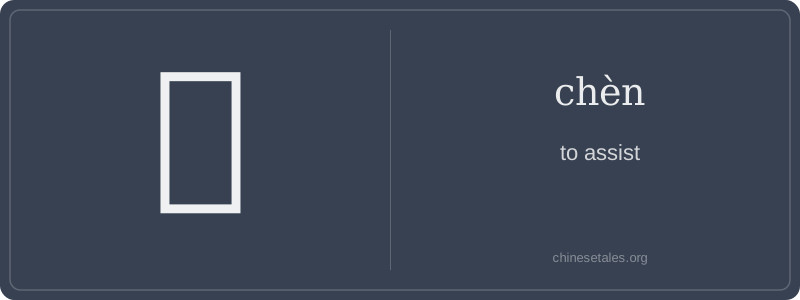
The earliest form of 儇 appears in late Han steles and Tang Buddhist inscriptions—not oracle bones—and is a phono-semantic compound: the left radical 亻 (person) signals human action, while the right component 覃 (tán, meaning ‘profound, extensive’) provides both sound and semantic depth. Visually, it evolved from clerical script where 覃 was written with a prominent ‘water’ (氵) base beneath a ‘west’ (西) top—suggesting something deep-flowing and far-reaching, like compassionate support that spreads widely without fanfare.
By the Tang and Song dynasties, 儇 became standardized in Buddhist texts like the Dunhuang manuscripts, consistently meaning ‘to offer material support for Dharma practice’. Classical references appear in records of lay donors ‘儇施香油’ (offering lamp oil) or ‘儇建佛塔’ (funding stupa construction). The character’s structure mirrors its meaning: a person (亻) extending profound (覃) aid—not just handing over coins, but investing spiritual intention into the act itself.
Imagine a quiet temple courtyard in Tang dynasty Chang’an: a young monk carefully places a folded silk scarf beside an elder’s alms bowl—not as a gift, but as a silent, respectful act of support. That gesture is 儭 (chèn): not loud or transactional, but humble, ritual-anchored assistance—often material aid given to monks, temples, or Buddhist causes. It carries reverence, not obligation; the ‘assistance’ here is spiritually weighted, almost devotional.
Grammatically, 儿 is almost never used alone—it appears only in compounds like 儇助 (chēnzhù) or 儇施 (chēnshī), and even then, it’s literary or religious. You won’t hear it in daily speech ('I’ll help you move' → 帮你, not *儇你). Learners mistakenly treat it like 帮 or 助—but 儇 is archaic, formal, and exclusively tied to merit-making contexts. Its verb use requires a noun object (e.g., 儇助僧人), never a clause (*儇他考试).
Culturally, 儇 reflects the deep link between generosity and karmic cultivation in Chinese Buddhism. Misusing it—say, in a casual WeChat message—sounds jarringly solemn, like quoting scripture at a coffee shop. And beware: it’s often misread as chèn (like 称), but its true reading is chèn—rhyming with ‘dawn’ (晨), not ‘ten’. That tonal slip can make your well-intentioned offering sound like a sarcastic remark!