儩
Character Story & Explanation
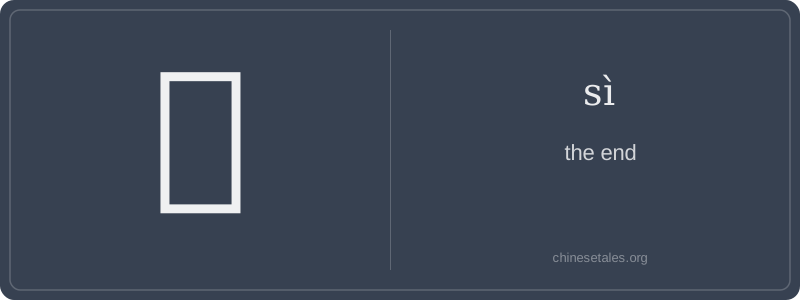
The earliest form of 儩 appears in bronze inscriptions from the late Zhou dynasty — not as a pictograph, but as a phonosemantic compound already. Its left side, 亻 (rén bàng), the 'person' radical, signals human agency or involvement. Its right side, 四 (sì), wasn’t chosen randomly: it’s both a phonetic clue (sì) *and* a semantic anchor — the number four, historically associated with completeness (four directions, four seasons) and thus, by extension, totality and exhaustion. Over centuries, the seal script standardized the form; clerical script slightly flattened the strokes; and regular script refined it into today’s clean, balanced structure — no frills, just stark symmetry reflecting its meaning.
This dual role of 四 — sound *and* sense — is brilliant wordplay: the character literally sounds like 'four' while evoking 'full cycle, full measure, full depletion.' Classical texts like the *Zuo Zhuan* use it sparingly but powerfully: '粮尽援绝,士卒儩尽' (liáng jìn yuán jué, shì zú sì jìn — 'grain exhausted, reinforcements cut off, soldiers utterly spent'). Notice how 儩 intensifies 尽 — not just 'exhausted,' but 'exhausted to the fourth degree.' Its visual minimalism — only seven strokes — belies its conceptual density: every line serves purpose, every component echoes finality.
Forget everything you know about 'the end' in Chinese — 儩 (sì) isn’t your everyday 结束 or 完. It’s a literary fossil, a single-character time capsule meaning 'utterly exhausted; completely used up; the very last drop.' Think of it as the semantic equivalent of slamming an empty teacup down: not just 'done,' but *depleted*. Its core feel is finality with residue — a quiet, almost melancholic totality. You won’t hear it in subway announcements or WeChat chats; it lives in classical poetry, historical texts, and formal written prose where precision and weight matter.
Grammatically, 儩 functions almost exclusively as a verb complement or adverbial modifier, often paired with verbs like 用 (yòng, to use), 尽 (jìn, to exhaust), or 耗 (hào, to consume). It rarely stands alone — you’ll see it in structures like '用尽了' or '耗尽了', but 儩 itself appears in fixed, elevated phrases like '荡然无存,一儩而空' (dàng rán wú cún, yī sì ér kōng — 'utterly vanished, emptied all at once'). Learners mistakenly try to substitute it for 完 or 了 — a fatal error: saying '我吃儩了' sounds like archaic poetry, not lunchtime report.
Culturally, 儩 carries the hush of irreversible loss — not dramatic collapse, but slow, total erosion: a well dried up, a family’s fortune spent, a generation’s memory faded. Modern writers sometimes resurrect it for ironic gravity ('这届年轻人把青春儩在了PPT里' — 'This generation has utterly spent their youth on PowerPoint'). The biggest trap? Assuming it’s common because it looks simple. In reality, its rarity makes mispronunciation (e.g., confusing sì with sī or shì) and misuse especially jarring to native readers.