儤
Character Story & Explanation
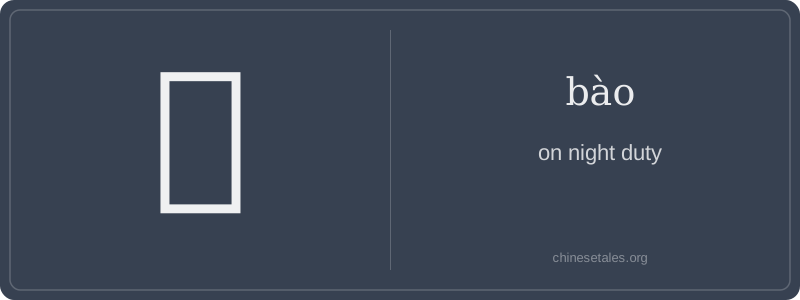
The earliest attested form of 儤 appears in Tang dynasty clerical script inscriptions and Song dynasty steles — not oracle bones or bronzes, since it’s a relatively late semantic compound. Its left radical 亻 (rén bàng, 'person') signals human agency, while the right component 雹 (báo, 'hail') is purely phonetic — no visual hailstones here! In fact, 雹 itself evolved from a pictograph of ice pellets falling from clouds, but in 儤, it contributes only sound (bào) and slight semantic weight: hail falls suddenly, unpredictably — much like the abrupt summons to night duty. The full character stabilized by the Yuan dynasty with its current 17-stroke structure: 亻 + 雹 (itself composed of 雨 + 包).
Historically, 儤 first appeared in Tang legal codes (e.g., the Tang Liudian) to designate rotating night watch duties for mid-level secretaries. By the Song dynasty, it became institutionalized in the Bureau of Military Affairs (Shumiyuan), where officials drew lots for 儤直 shifts — recorded meticulously in daily logs. Its visual pairing of 'person' and 'hail' subtly evokes vulnerability and exposure: the official stands alone under the cold, sudden 'hail' of imperial demand. No classical poem celebrates 儤 — it’s too administrative for poetry — but Sima Guang’s Zizhi Tongjian notes how exhausted 儤直 officials once delayed urgent edicts, proving this humble character once held real administrative gravity.
Think of 儤 (bào) as China’s ancient version of a 'night shift badge' — not a modern HR term, but a highly specific bureaucratic label used for over a thousand years to denote officials assigned to overnight duty in imperial government offices. Unlike general words for 'duty' like 值班 (zhí bān), 儤 carries an unmistakable historical scent: it implies formal rotation, imperial sanction, and a quiet, candlelit vigil in the Hall of Military Affairs or the Secretariat — not just staying late at your startup office. Its meaning is narrow, almost ceremonial: you don’t 'do 儤' casually; you are *assigned* 儤, often by rota.
Grammatically, 儤 functions almost exclusively as a noun — never a verb — and appears almost always in classical or literary compounds like 儤直 (bào zhí) or 儤役 (bào yì). You’ll rarely see it alone in speech or modern writing; instead, it surfaces in historical novels, archival documents, or academic discussions of Tang/Song bureaucracy. Learners mistakenly try to use it like 值班 ('to be on duty'), leading to unnatural phrasing — e.g., *‘我儤了’ is ungrammatical and confusing; the correct expression is ‘我被派去儤直’ (I was assigned to night duty).
Culturally, 儤 reflects how precisely the imperial system codified time, labor, and hierarchy: even sleep was bureaucratically scheduled. It’s absent from HSK because it’s functionally obsolete — yet still appears in period dramas and official histories, making it a linguistic 'fossil' that reveals how deeply administration shaped Chinese language. Mistake it for a common character? You’ll sound like someone quoting Ming dynasty court minutes at a coffee shop.